Biohacker Summit 2024 Helsinki
The Device In Our Hand, The Disorder In Our Lives
By Teemu Arina · · Updated
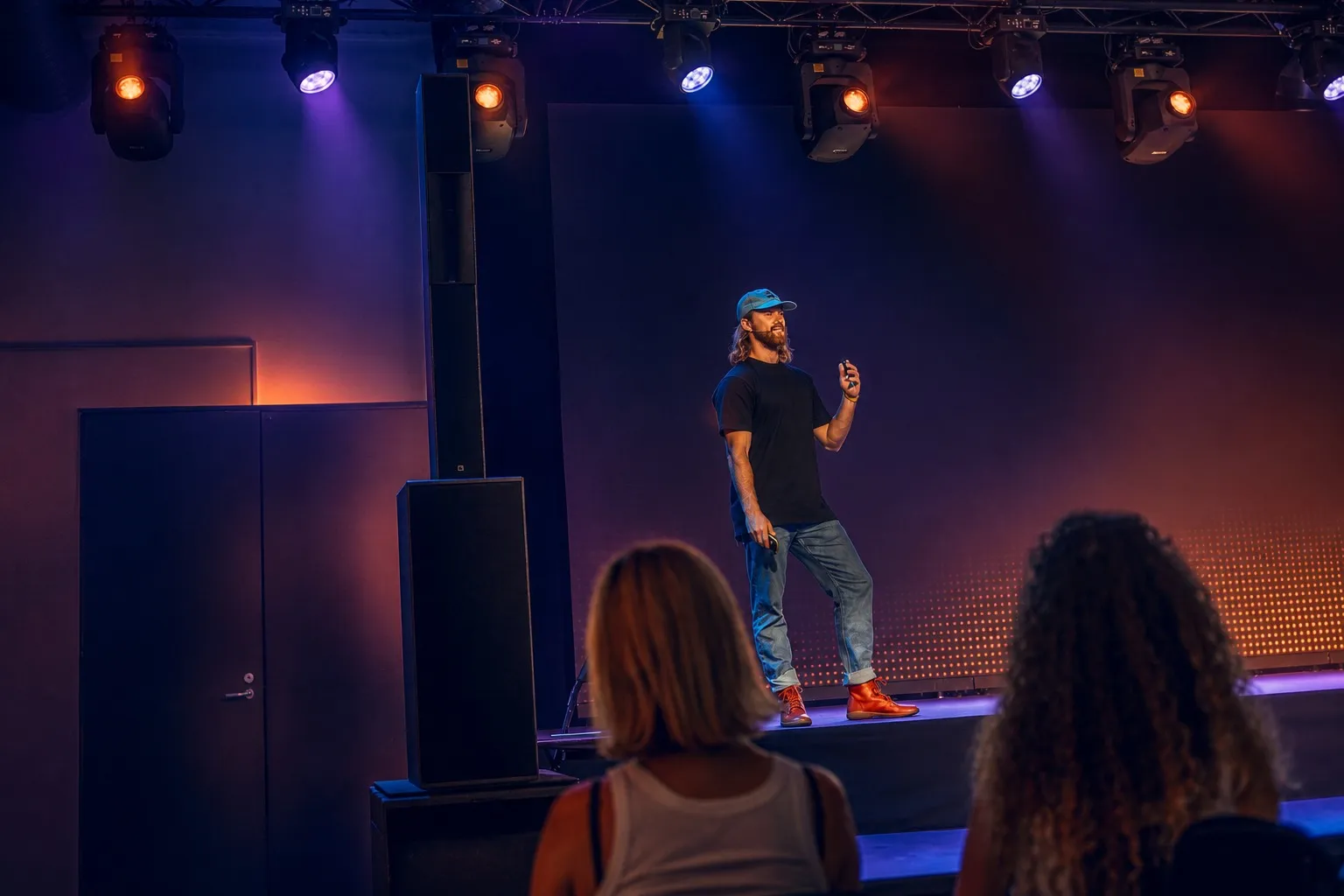
At Biohacker Summit In Helsinki, Tristan Scott Argued That Modern Technology Had Become An Environmental Health Threat, And That Healthier Screens Must Be Built To Work With Nature Rather Than Against It
At the Biohacker Summit in Helsinki on Wednesday, 3 July 2024, Tristan Scott stood before an audience already fluent in the language of optimisation and longevity and delivered a message less about enhancement than restraint. His presentation, The Impact of Modern Technology on Health, asked a disquieting question: what if the tools that promised connection, productivity and progress had also helped drive a chronic disease epidemic and a deepening mental health crisis?
Scott, an electrical engineer by training and now marketing lead at Daylight Computer Co., spoke with the urgency of a convert. He traced his own route into health research through personal injury, describing how concussions in his early twenties pushed him into what he called a self-healing rabbit hole. That search, he suggested, exposed not only the limits of conventional healthcare, but the broader architecture of modern life: indoor living, artificial light, addictive design, electromagnetic exposure, and a culture that had come to accept sickness as normal.

“We’re in 2024, we know more than we ever have as a species,” Scott said. “However, we’re sicker than ever.”
A Crisis Hidden In Plain Sight
Scott’s argument was not that technology alone explained the rise in chronic illness or depression. Food systems, toxins, chemical exposure, alcohol, smoking and stress all formed part of the picture. But he insisted that the technological environment remained underexamined precisely because it was so pervasive, so profitable and so difficult to escape.
“Our technology in the current state is harmful for our health, and we’re spending an ever-increasing amount of time on our devices,” he said.
The force of his talk lay in this claim of ubiquity. Screens were not a niche concern. They were the atmosphere of modern existence. Work, school, leisure, friendship, entertainment and even self-improvement now passed through illuminated rectangles. What once seemed like neutral tools had become, in Scott’s framing, biological inputs, shaping sleep, mood, energy, attention and development.
He described a world in which adults spent six to seven hours a day on screens, and children often far more. The technology was not merely present. It was formative.
Childhood On A Screen
The most emotionally charged section of Scott’s presentation focused on children. Here, his critique sharpened from unease to alarm. He spoke of rising mental health problems among the young, of soaring screen exposure, of social media as both a behavioural engine and a developmental environment.
“The longer that you waited as a parent to give your child a smartphone, the better their mental health was,” he said, pointing to data that linked later smartphone ownership with stronger mental wellbeing.
His point was not simply that screens distracted children. It was that they instructed them, shaping reward systems, social cues and emotional expectations at an age when the architecture of self was still under construction. A child soothed by a tablet, captivated by algorithmic content and rewarded by digital stimuli was, in his telling, being trained into dependency before they could understand its cost.
What disturbed Scott was the way this arrangement had been normalised. Devices offered convenience to exhausted households, educational institutions and overburdened parents. But in solving one problem, he suggested, society had quietly created another.
The Indoor Species
One of Scott’s central themes was that technology did not merely affect users through what appeared on a screen. It changed where people spent their lives. Humans now passed roughly 90% of their time indoors, he said, severed from the conditions under which biology had evolved.
Outside, in Scott’s account, lay full-spectrum sunlight, fresh air, microbial diversity, contact with the earth and the natural electromagnetic field. Inside lay artificial illumination, static climates, processed environments, insulated surfaces and a dense web of man-made signals.
His language was often sweeping, but the underlying contention was clear: health was not simply a matter of nutrients and exercise, but of environmental coherence. The body expected cues from the natural world and suffered when those cues were replaced by synthetic substitutes.
“Our organs, our bodies are running on the same concept of time in any system in the world,” Scott said. “It needs to be in sync to be very efficient and to work properly.”
That idea of synchrony anchored much of the talk. Artificial light, especially at night, disrupted circadian timing. Blue-heavy screens delivered signals the brain interpreted as daytime. Flickering LEDs added stress. Radio frequencies and wireless systems formed another layer of exposure. The consequence, Scott argued, was not a single symptom but a broad condition of physiological confusion.
Blue Light, Flicker And Biological Chaos
Scott broke his case against modern devices into four broad harms: they kept people indoors, exposed them to unnatural light spectra, subjected them to flicker and radio frequencies, and were deliberately engineered to be addictive.
The emphasis on blue light was especially strong. Blue wavelengths, he said, acted as powerful time-setters for the brain’s master clock. In daylight, that signal was natural and useful. At night, delivered by phones, tablets and laptops, it became disruptive. The result was suppression of melatonin, disturbance to circadian rhythms and what Scott described as downstream inflammation and disorder.
He paired this with a warning about flicker, the rapid modulation of light intensity common in LED devices and lighting systems. Though often imperceptible to the naked eye, he argued that it could contribute to eye strain, headaches and neurological stress. Then came radio frequency exposure, which he described as a vast and poorly understood experiment being conducted in real time on entire populations.
To critics, some of this framing would seem to move faster than scientific consensus. But Scott’s confidence never wavered. He spoke less as a tentative analyst than as someone convinced that the burden of proof had shifted. For him, the question was no longer whether modern technological conditions were biologically costly, but how long societies would continue to ignore the bill.
The Business Model Of Overstimulation
Scott was at his most incisive when he turned from physics to incentives. Devices, he argued, were not accidentally overwhelming. They had been refined inside economic systems that rewarded attention capture, prolonged engagement and behavioural dependency.
The issue was not only the screen’s light output, but the commercial logic behind it. Platforms wanted users stimulated, scrolling, reacting and returning. The dopamine cycle was not a side effect. It was a design principle.
That insight gave the talk a political undertone. Scott’s broader commitments, including decentralisation and what he called sovereign living, ran through his diagnosis of the problem. Big technology companies, he suggested, had little reason to produce healthier devices when their profits depended on maximising use.
A Different Kind Of Computer
This was the point at which critique turned to pitch. Scott now works for Daylight Computer Co., and his presentation closed by introducing the company’s answer: a blue light-free, flicker-free computer designed to be used in alignment with natural rhythms.
He described it as a device intended to preserve productivity without exacting the usual physiological tax, with a display that could function outdoors in direct sunlight and an amber-toned nighttime mode meant to reduce circadian disruption.
“We want to be able to have technology that allows us to be productive but in sync with nature,” Scott said.
That line captured both the appeal and the tension of the talk. Scott did not call for the rejection of technology. He called for its redesign. The future, in his vision, was not pre-digital but post-negligent: tools that recognised the human body not as an obstacle to efficiency, but as the condition of any meaningful progress.
The Uneasy Truth Of A Bright Age
What made Scott’s presentation resonate at Biohacker Summit was not simply its catalogue of harms. It was its framing of sickness as a design problem. If modern people were exhausted, inflamed, anxious, sleepless and distracted, perhaps this was not a personal failure to optimise, but a rational response to an irrational environment.
There was something unsettling in that thought. It suggested that the glowing objects through which people worked, learned, relaxed and loved were not innocent furniture of daily life, but active participants in a public health story still being written.
Scott’s talk did not pretend the solution would be easy. To spend more time outdoors, reduce screen exposure, block blue light, hardwire internet and use less invasive devices required intention in a world built for frictionless convenience. Yet his challenge landed with moral clarity. If technology had reshaped the conditions of human health, then health itself could no longer be discussed without confronting technology.
In Helsinki, under the banner of Biohacker Summit, Tristan Scott made that confrontation impossible to avoid.
Frequently asked questions
What is Tristan Scott's argument about technology?
That the technological environment is an underexamined driver of chronic illness, precisely because it is so pervasive, so profitable and so hard to escape. He was careful not to claim technology alone explains the rise, naming food systems, toxins, alcohol, smoking and stress alongside it.
What does he say about children and smartphones?
Scott pointed to data suggesting that the longer a parent waited before giving a child a smartphone, the better that child's mental health was. It was the most emotionally charged part of his talk, where his critique sharpened from unease to alarm.
How much time do we spend indoors?
Roughly 90%, according to Scott, severed from the conditions under which human biology evolved. Outside, in his account, lie full-spectrum sunlight, fresh air, microbial diversity, contact with the earth and the natural electromagnetic field.
About the event
This recap is part of the Biohacker Summit 2024 Helsinki series, recorded in Helsinki on 2 and 3 July 2024. Read the summary of the whole event or join the next edition, HOLOLIFE Summit 2026 Amsterdam, on 14 and 15 November 2026.
In this story
Comments
Loading comments…