Biohacker Summit 2024 Helsinki
Bridging Science & Soul With Psychedelics
By Teemu Arina · · Updated
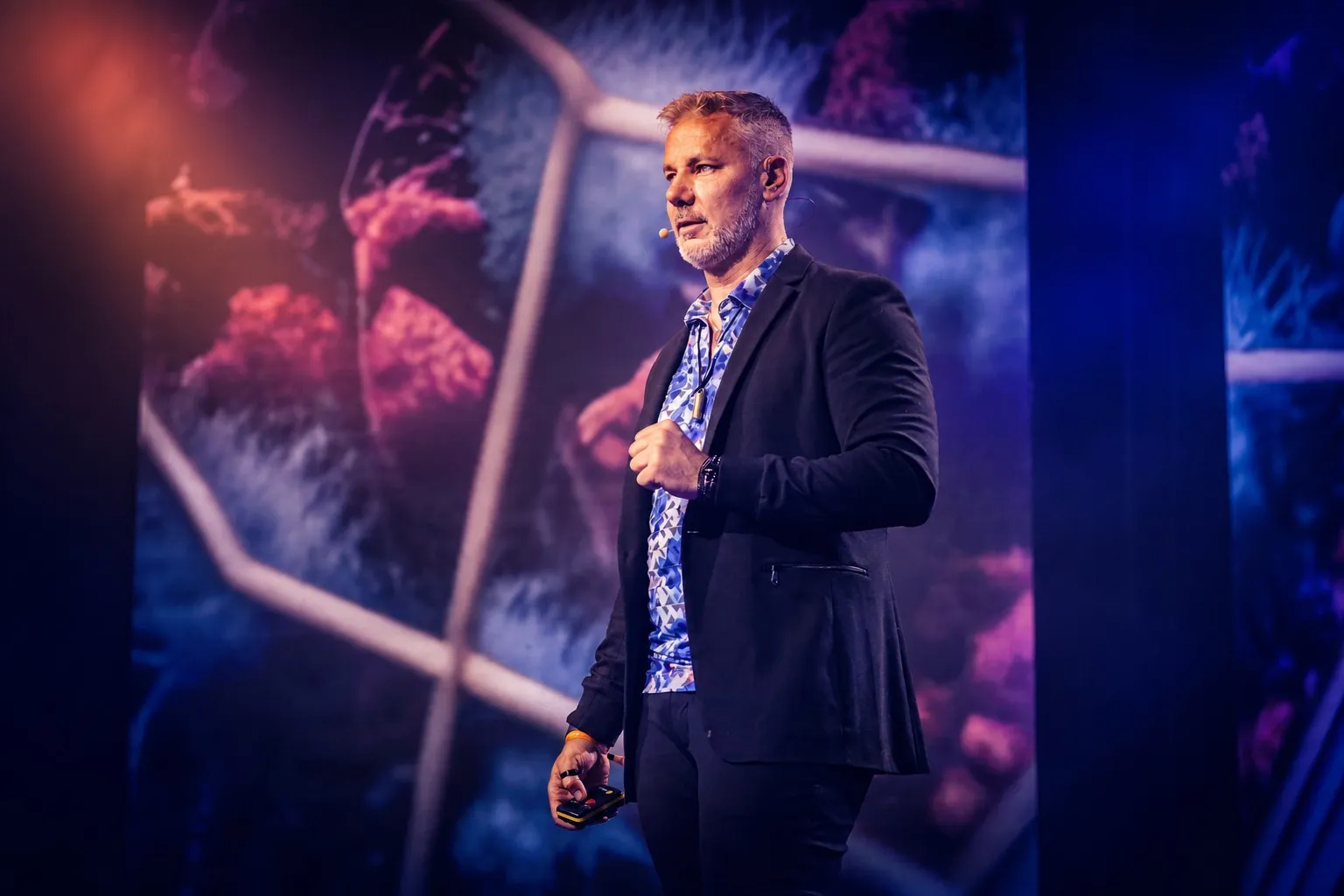
A One-Line Description
At the Biohacker Summit in Helsinki, Shawn Wells made an impassioned case that psychedelics belonged not at the fringes of medicine, but near its wounded heart.
A Crisis Bigger Than The Stigma
On Tuesday, 2 July 2024, at the Biohacker Summit in Helsinki, Finland, Shawn Wells stepped onto the stage with a presentation titled Bridging Science & Soul With Psychedelics and set out to challenge one of modern health culture’s deepest contradictions: that while depression, PTSD and anxiety had spread with startling force, some of the most promising tools for treating them remained culturally suspect, legally constrained and medically underused.
Wells, a nutritional biochemistry expert, registered dietitian and supplement formulator known across the wellness industry, did not present the subject as an abstract frontier. He framed it as urgent, personal and moral. The real pandemic, he argued, was not simply infectious disease or burnout rhetoric, but the steep rise in mental distress, antidepressant dependence and suicide.
His case rested on a stark contrast. Traditional antidepressants, he said, had often delivered modest gains at best, while psychedelic compounds such as psilocybin, MDMA and DMT were producing outcomes that sounded less incremental than transformational.
The Numbers That Commanded The Room
Wells leaned heavily on statistics to move the conversation beyond counterculture mythology and into the language of evidence.
Among the most arresting claims was this: “Participants ranked their psilocybin experience as one of the most meaningful in their lives, comparable to the birth of a first child or death of a parent.”
That statement gave the talk its emotional centre. Psychedelics, in Wells’s telling, were not merely symptom-management tools. They could become experiences of existential reordering, moments that altered a person’s sense of self, meaning and connection.
He followed with data meant to show that public resistance was softer than many assumed. “83% of those experiencing anxiety, depression, PTSD are open to these alternative treatments. About two thirds are open to these different psychedelics.”
Then came the figures he clearly regarded as the most difficult to ignore. “71% of people in this study that took psilocybin for depression showed a greater than 50% reduction in symptoms in four weeks.” In the same line of argument, he cited strong PTSD outcomes with MDMA-assisted therapy, describing rates of improvement that far exceeded what many patients had come to expect from conventional psychiatric care.
For Wells, these were not niche findings. They were signs that a therapeutic revolution had already begun, only unevenly and often outside mainstream systems.
Neuroplasticity As Hope
A central theme of the presentation was neuroplasticity, the brain’s capacity to change, rewire and form new patterns. Wells described depression not only as a mood disorder but as a state of diminished connection, reduced adaptability and neurological contraction. Psychedelics, he said, appeared to reverse that condition by promoting new neural pathways, increased brain-derived neurotrophic factor and wider communication across brain networks.
This was where the “science” and “soul” of the presentation most clearly met. The biological argument was that psychedelics could foster synaptogenesis, neurogenesis and reduced neuroinflammation. The human argument was that this rewiring could make room for new beliefs, new emotional possibilities and a loosening of rigid self-stories.
In Wells’s formulation, the compounds mattered not only because they changed chemistry, but because they changed perspective. “Psychedelics are not drugs in the usual sense of the word. They are catalysts for transformation.”
That phrase captured the thesis of the event session: the medicine was not merely molecular, but experiential.
A Rebuke To The Antidepressant Era
Part of the force of Wells’s presentation came from its direct challenge to the pharmaceutical status quo. He cited meta-analyses questioning whether standard antidepressants consistently delivered benefits that outweighed harms, and he argued that the serotonin-only model of depression had long been too narrow.
In his account, psychedelics acted through multiple pathways at once: neurotransmitter modulation, inflammation reduction, ego suppression, increased parasympathetic activation and heightened neuroplasticity. By comparison, the long-term, often blunted management offered by conventional drugs appeared limited.
This was not a neutral critique. Wells suggested that broader adoption of psychedelic therapies threatened entrenched commercial interests. If people became less dependent on lifelong medication because they felt more connected to themselves, nature, family or God, then a powerful economic structure would lose ground.
It was a provocative argument, and one that resonated with a crowd predisposed to question institutional medicine. But Wells anchored it not in abstract rebellion, rather in clinical frustration and the growing demand for alternatives.
The Personal Testimony That Changed The Tone
If the data established credibility, Wells’s own story gave the talk its gravity.
He told the Biohacker Summit audience that he had once stood on the edge of suicide despite outward success. He had money, professional status and public recognition, yet remained trapped in exhaustion, insecurity and a gnawing conviction that he was never enough. Psilocybin, he said, changed that.
The most powerful moment of the session came when he described a revelation from his first psychedelic experience, not as spectacle, but as emotional truth. “I can just have love. That changed everything in my life. It changed the energy that I approached everything with.”
The simplicity of the sentence was the point. Wells was not claiming that psychedelics had granted him secret knowledge. He was saying they had allowed him to feel, in a way he had never truly embodied before, that love did not need to be earned through performance.
In a summit setting often dominated by optimisation language, biomarkers and productivity culture, that confession cut through. It turned the presentation from a survey of therapeutic potential into a testimony about survival.
The Biohacker’s Addition: Stacks, Fasting And Recovery
True to his reputation, Wells did not stop at advocacy. He also offered what might be called a biohacker’s framework for supporting psychedelic work before, during and after a journey.
He spoke about fasting to elevate ketones and improve brain energetics, hydration and electrolytes to support resilience, magnesium and taurine for nervous system regulation, and compounds such as lion’s mane, B vitamins, saffron and adaptogens to support neuroplasticity, serotonin balance and recovery. He also discussed microdosing protocols, ketamine-assisted reset models and nootropic combinations intended to extend the window of change after a psychedelic experience.
The implication was clear: insight alone was not enough. If psychedelics opened a door, the body and brain still needed support to walk through it. He repeatedly returned to the idea that the post-journey period mattered deeply, because that was when new patterns could either take root or fade.
In this framing, psychedelics were not magic bullets. They were catalysts, and catalysts required context.
A Call For Access, Not Just Awe
What lingered after Wells’s talk at the Biohacker Summit was not simply the promise of better therapies, but the insistence that access itself had become an ethical question.
He spoke of soldiers, paramedics and survivors of violence who might benefit from these treatments yet could not reach them. He argued that even sceptics should care, not because every person needed psychedelics, but because some people were dying without options that might help them live.
That was the emotional and political charge of Bridging Science & Soul With Psychedelics. It was not merely a presentation about compounds, protocols or neurochemistry. It was an appeal to rethink what healing could look like when medicine took meaning seriously, when science allowed room for transcendence, and when mental healthcare was judged not by its familiarity, but by its ability to relieve suffering.
In Helsinki, Shawn Wells made the case that psychedelics should no longer be discussed as cultural curiosities. They should be considered as tools of treatment, instruments of renewal and, for some, a final bridge back to life.
Frequently asked questions
What is Shawn Wells's case for psychedelics?
That while depression, PTSD and anxiety have spread with startling force, some of the most promising tools for treating them remain culturally suspect and legally constrained. He argued psychedelics belong near the wounded heart of medicine rather than at its fringes.
How meaningful do participants find these experiences?
Wells cited research in which participants ranked their psilocybin experience as one of the most meaningful of their lives, comparable to the birth of a first child or the death of a parent. He used the finding to move the conversation from counterculture into evidence.
What is his criticism of the antidepressant era?
Wells cited meta-analyses questioning whether standard antidepressants consistently deliver benefits that outweigh harms, and argued the serotonin-only model of depression had long been too narrow. Psychedelics, in his account, act through several pathways at once.
About the event
This recap is part of the Biohacker Summit 2024 Helsinki series, recorded in Helsinki on 2 and 3 July 2024. Read the summary of the whole event or join the next edition, HOLOLIFE Summit 2026 Amsterdam, on 14 and 15 November 2026.
In this story

Comments
Loading comments…