Biohacker Summit 2024 Helsinki
'Microdosing the atmosphere': the ancient biohack that could transform our health
By Teemu Arina · · Updated
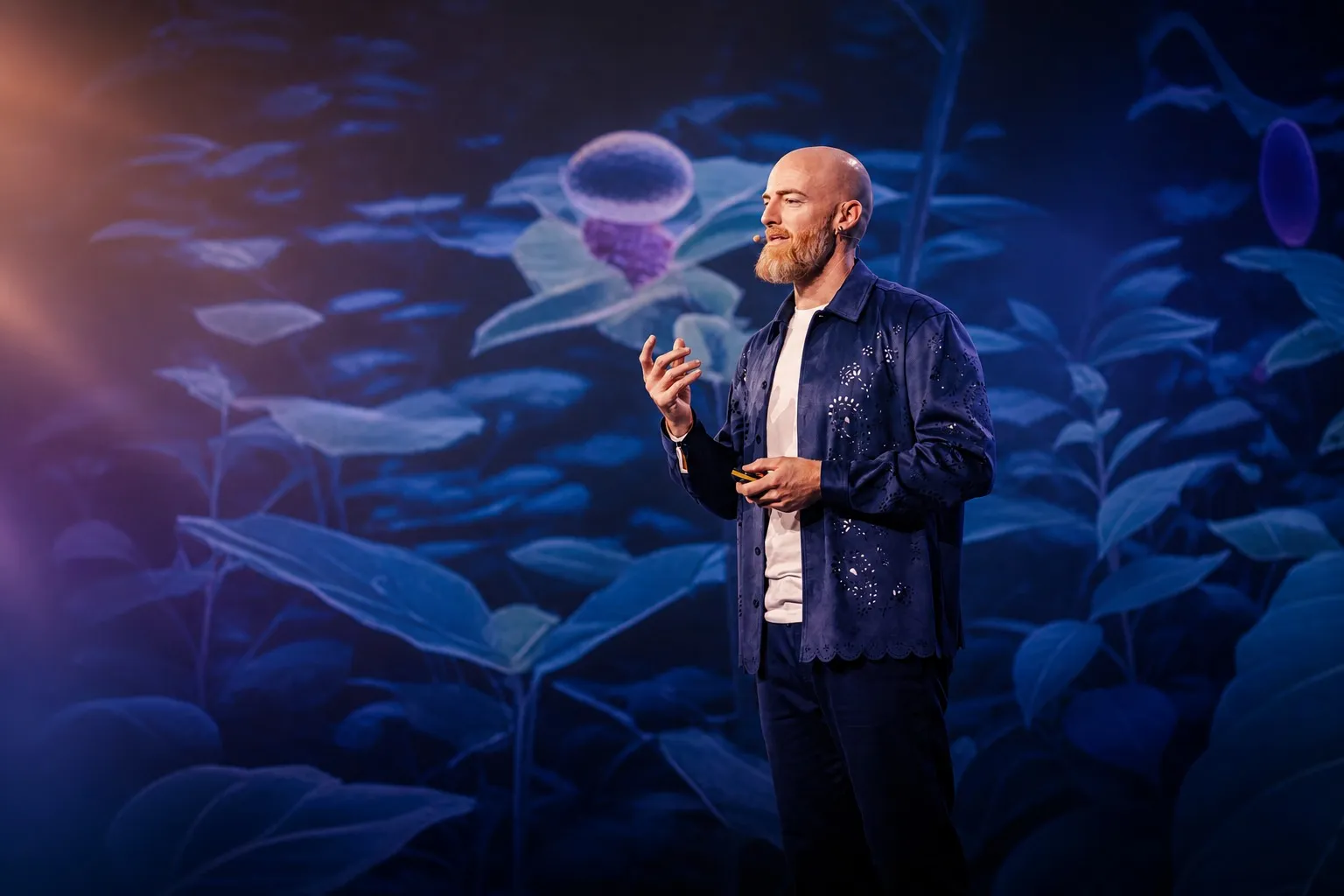
In the high-tech world of biohacking where enthusiasts often seek cutting-edge gadgets and supplements, breathwork coach Leigh Ewin made a compelling case for what might be the most accessible performance enhancement tool available: conscious breathing. Speaking at the Biohacker Summit in Helsinki on Tuesday, Ewin presented breathing not merely as a biological necessity, but as a powerful technique for improving energy, longevity, and human connection.
"The health journey can be super lonely," Ewin told attendees at the three-day summit, which concludes Wednesday. "It can ostracize us from our family and friends. But here, we know that others are here, so it's good to connect and share these moments."

From water to land: the evolutionary basis of breathing
Central to Ewin's presentation was the evolutionary journey that gave humans our respiratory capabilities. He highlighted Tiktaalik, a prehistoric lobe-finned fish that lived 380 million years ago, as "one of the ultimate biohackers in Earth's history."
"Like the ultimate biohacker Tiktaalik, microdosing the toxic atmosphere shaped evolution, giving us lungs and breath for life," Ewin explained, describing how the creature's periodic emergence from water to air eventually led, over millions of years, to the development of lungs and our modern respiratory system.
This evolutionary perspective grounded Ewin's approach in science while providing a fresh framework for understanding breathing practices. The shift in atmospheric composition over time – from high carbon dioxide levels to our current oxygen-rich environment – paralleled the development of our breathing apparatus.
Breathing for energy and regulation
Ewin challenged the audience to reconsider breathing's fundamental purpose. "Breathing is the way your body produces energy; oxygen breaks down nutrients to form ATP—energy for the body to use," he said, explaining the biochemical basis for respiration.
But the benefits extend far beyond basic energy production. According to Ewin, conscious breathing influences hormone production, blood chemistry, digestive function, lymphatic circulation, and emotional regulation. "We are all our own alchemists of our body," he noted, explaining how breathwork can alter physiological markers like white and red blood cell counts.
The longevity link
Perhaps most intriguing were Ewin's claims about breathing and longevity. "Lungs, breath, and CO2 levels determine longevity; lowering the breath rate brings us to a calmer, more vibrant state," he stated.
While the average adult breathes 15-18 times per minute, Ewin suggested that the optimal "Zen level" is just 6-12 breaths per minute. To demonstrate, he guided the audience through the 4-7-8 breathing technique (inhaling for four seconds, holding for seven, and exhaling for eight).
"You can already feel the shift inside this atmosphere," he observed as participants completed the exercise, many visibly relaxing as their breathing slowed.
Sea nomads and the spleen connection
In one of the presentation's most fascinating segments, Ewin discussed the Bajau Lao tribe from the Philippines, whose members can dive to depths of 75 meters while foraging for food. Research has shown that these sea nomads have evolved spleens approximately 50% larger than those of mainland dwellers.
"The spleen is located on the left side of the body, about the size of an avocado, and it's actually the biggest organ in the lymphatic system," Ewin explained. During breath holds, the spleen contracts to release oxygen-rich blood, extending underwater endurance – a natural adaptation that breathwork can potentially stimulate even in non-divers.
To demonstrate the power of breath holding, Ewin led the audience through controlled pauses, explaining that rising carbon dioxide levels actually improve oxygen delivery by triggering its release from hemoglobin in the blood.
Creating shared atmosphere
Perhaps most uniquely, Ewin emphasized the social and communal aspects of breathing. He began his presentation by asking audience members to hug and breathe together, noting how shared breath creates a collective "atmosphere" – a word he traced to its Latin roots meaning "vapor sphere."
"Connection slows everything down; just take a few breaths with someone and feel the safe atmosphere we create together," Ewin said, suggesting that synchronized breathing fosters psychological safety and social bonding.
He likened it to entering a meeting late: "You kind of have to wait and sense the atmosphere. These people have been breathing together, releasing vapor into the atmosphere, into this little room, and they're already in the same vibe."
The nasal breathing advantage
Ewin concluded by highlighting the importance of nasal breathing, which produces nitric oxide – a molecule with vasodilating, antibacterial, and antifungal properties. "It's like a turbocharger in a car," he said, explaining how this compound enhances oxygen uptake and respiratory health.
By contrast, mouth breathing bypasses this mechanism entirely. "When you breathe through your mouth, you lose the benefits. It's as simple as that," he said, advocating for consistent nasal breathing as a simple but powerful health practice.
As the Biohacker Summit continues in Helsinki until Wednesday, Ewin's presentation offered a reminder that sometimes the most effective health interventions aren't found in cutting-edge technology, but in conscious attention to the most fundamental human function: the simple act of breathing.
Frequently asked questions
What does Leigh Ewin mean by microdosing the atmosphere?
He drew the phrase from Tiktaalik, a prehistoric lobe-finned fish that lived 380 million years ago and which he called one of the ultimate biohackers in Earth's history. Microdosing the toxic atmosphere shaped evolution, he argued, giving us lungs and breath.
How many breaths per minute are optimal?
Ewin said the average adult breathes 15-18 times per minute, while what he called the Zen level is just 6-12 breaths per minute. He demonstrated with the 4-7-8 technique, and argued that lowering the breath rate brings the body to a calmer, more vibrant state.
What can sea nomads teach us about breathing?
Ewin discussed the Bajau Lao tribe from the Philippines, whose members dive to depths of 75 metres while foraging. Research has shown that these sea nomads have evolved physiological adaptations, which he used to illustrate how far human respiratory capacity can be shaped.
About the event
This recap is part of the Biohacker Summit 2024 Helsinki series, recorded in Helsinki on 2 and 3 July 2024. Read the summary of the whole event or join the next edition, HOLOLIFE Summit 2026 Amsterdam, on 14 and 15 November 2026.
In this story

Comments
Loading comments…