News
Anti-Inflammatory Diet: A Practical, Evidence-Led Guide
By Teemu Arina ·

FOCUS KEYWORD: anti inflammatory diet
An anti inflammatory diet is a long-term eating pattern, not a list of special ingredients. It centres on vegetables, legumes and minimally processed foods, with nourishing fats and balanced carbohydrates. A Mediterranean-style pattern is one practical model; food supports health but does not replace medical care or guarantee results.
What an anti-inflammatory diet can and cannot do
Inflammation is part of the body’s normal immune response. An anti-inflammatory eating pattern does not eliminate it, but favours foods associated with better health and, in some settings, lower systemic inflammation.
A 2022 review describes the traditional Mediterranean diet as largely plant-based and links greater adherence with lower risk of cardiovascular disease, diabetes, some cancers and death from any cause. It also reports evidence for secondary prevention of cardiovascular disease, potentially through reduced systemic inflammation rather than cholesterol or weight changes alone. The diet is a useful template, not a guarantee (review of the Mediterranean diet’s anti-inflammatory effects).
Consider the pattern across days and weeks, rather than labelling individual foods “good” or “bad”. A clinical review describes whole, plant-based foods, healthy fats and phytonutrients, with attention to steady blood sugar responses (clinical review of anti-inflammatory diets).
Diet cannot diagnose pain, fatigue or abnormal test results, or serve as a cure. For rheumatoid arthritis, nutrition may complement medical treatment; a review recommends a Mediterranean-style diet and individualised dietary support (review of nutrition in rheumatoid arthritis).
Anti inflammatory diet: the foods to build meals around
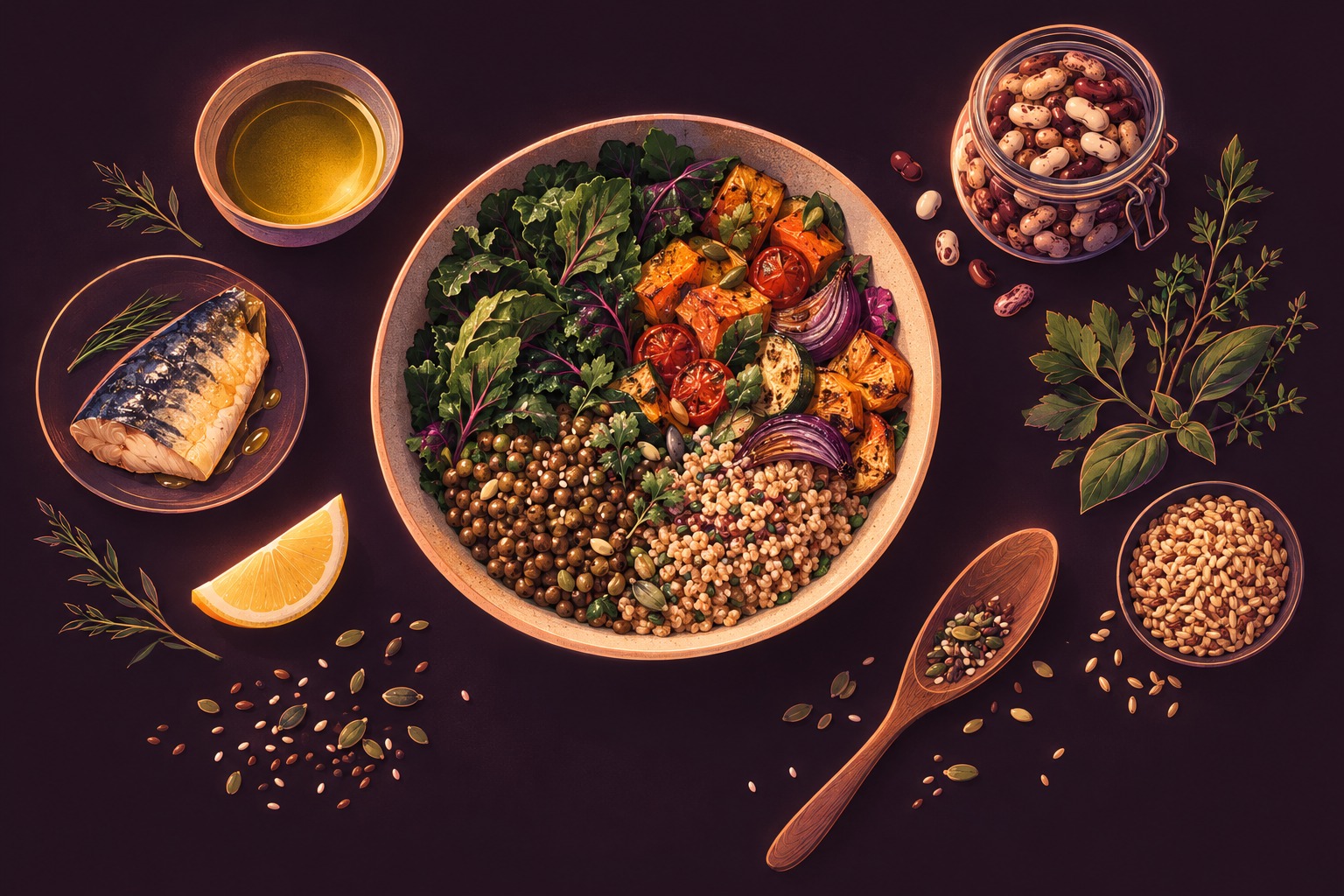
A plant-rich meal of vegetables, lentils and grains sits alongside olive oil, fish and herbs.
Build meals from familiar, minimally processed ingredients to make the overall pattern more plant-rich, rather than chasing a list of anti-inflammatory foods.
Vegetables and legumes are a useful foundation. Among women over 50, greater adherence to an anti-inflammatory Mediterranean pattern was associated with fewer subjective memory complaints; greens, other vegetables and legumes were among components associated with a protective pattern. This does not show that any single food prevents memory problems (study of Mediterranean-style diets and subjective memory complaints).
Choose less-refined grains more often. Whole or minimally refined grains fit alongside vegetables and legumes. A review of nutrition and type 2 diabetes risk describes increasing less-refined carbohydrates as broadly consistent with public health guidance, while noting that evidence linking diet and inflammation varies in strength (review of nutrition, inflammation and type 2 diabetes risk).
Include healthy fats. Olive oil is common in the Mediterranean model, and oily fish is another option. For rheumatoid arthritis, a review recommends oily fish at least twice a week and discusses omega-3 supplements as an alternative or addition, not a universal prescription (review of nutrition in rheumatoid arthritis).
Use herbs and spices to flavour vegetable, bean and grain dishes. At HOLOLIFE Summit 2025 Tokyo, Siim Land discussed evidence for turmeric’s anti-inflammatory effects; spices or extracts cannot compensate for an unbalanced diet.
Make plants the default, adding protein and fats to suit preferences, budget and health needs. Frozen vegetables, tinned beans and simple whole-grain staples help; specialist products are unnecessary.
Which foods may be worth limiting
Consider foods within the overall pattern rather than labelling each “inflammatory” or “anti-inflammatory”. The 2017 clinical review includes limiting foods that promote inflammation. A review of nutrition and type 2 diabetes risk also identifies reducing saturated fat, choosing less-refined carbohydrates and maintaining a healthy weight as broadly consistent with public health guidance, while noting that some evidence about foods and disease risk is observational.
In the study of women over 50, refined grains, sugar, pastries, cakes and dairy products were associated with increased risk of subjective memory complaints. This does not prove any food causes memory problems or mean everyone should avoid dairy. Consider overall eating patterns and individual needs, not a universal ban based on one study.
Ultra-processed foods are also worth considering in overall diet quality. At Biohacker Summit 2024 Helsinki, Ari Tulla argued that highly processed food is a major concern for health and obesity. The evidence here does not show that a particular food or product directly causes inflammation in an individual.
If packaged snacks, sweetened drinks or refined-grain foods routinely crowd out vegetables, legumes and less-refined staples, gradually changing that balance may be more practical than an all-or-nothing rule.
A simple anti-inflammatory diet meal plan
This flexible example draws on the plant-rich pattern in the Mediterranean and clinical reviews; a meal plan need not be rigid or identical each day.
- Breakfast: oats with fruit and nuts or seeds. Choose plain oats and add sweetness if wanted, rather than relying on a heavily sweetened packaged option.
- Lunch: lentils or beans with leafy greens, other vegetables, a whole-grain base and an olive-oil-based dressing.
- Snack: fruit, or vegetables with a bean-based dip.
- Dinner: oily fish with roasted vegetables and a whole-grain side, or beans or lentils with the same vegetables and grains.
- Flavour: add herbs, spices, lemon or vinegar to suit the dish.
These are examples, not a prescribed menu. People who avoid fish can choose other proteins; allergies, digestive symptoms or health conditions may call for different options. A repeatable structure is more useful than a hard-to-follow perfect plan.
Start with one manageable change, such as adding vegetables to lunch or swapping a refined-grain side for a less-refined one. Aim for a sustainable pattern that fits appetite, routine and preferences.
When supplements may fit and how to assess them
Food should usually come first. Supplements may suit a specific need or clinical context, but broad claims can outpace evidence.
At HOLOLIFE Summit 2025 Tokyo, Siim Land discussed omega-3 supplements, noting that decisions depend on a person’s usual diet and omega-3 status. A rheumatoid arthritis review discusses supplementation alongside oily fish and a Mediterranean-style diet; this is not a general recommendation.

Siim Land
“Omega-3 fatty acids reduce risks of cardiovascular events and mortality, improve inflammation, endothelial function, blood sugar, and insulin sensitivity.”
— Siim Land, HOLOLIFE Summit 2025 Tokyo
Land also highlighted turmeric’s anti-inflammatory potential. His talk does not establish that turmeric supplements are necessary, suitable for everyone or equivalent to culinary turmeric. Before starting one, consider its intended benefit and whether a clinician or pharmacist should check for interactions with medicines or other supplements.
Land warned that the supplement market can be poorly regulated and recommended third-party testing and certificates of analysis. A label alone does not prove quality or effectiveness. Supplements should not replace medical care for ongoing symptoms or a diagnosed condition.
Using wearables and AI to spot nutrition patterns
Wearables and food-tracking apps can reveal routines, such as skipped meals, missing vegetables at lunch, or changes in sleep and activity. They can prompt questions or small experiments, but cannot identify the cause of inflammation or diagnose a condition.
At Biohacker Summit 2024 Helsinki, Ari Tulla discussed using real-time body information to guide nutrition and behaviour. Use devices cautiously: observe patterns and test practical changes, rather than treating an algorithm’s suggestion as a clinical finding.

Ari Tulla at Biohacker Summit 2024 Helsinki
“AI turns real-time data from our bodies into the right actions and supercharges food as medicine and behavior change.”
— Ari Tulla, Biohacker Summit 2024 Helsinki
A short tracking exercise could record meals and one or two routines, such as sleep or activity, then look for repeatable patterns. Avoid interpreting every fluctuation. The talks describe potential uses, but do not validate any AI system for diagnosing inflammation or prescribing a diet.
Personalisation can be modest: identify a changeable habit, try a realistic adjustment and assess whether it works. For repeated unusual readings or persistent symptoms, seek qualified medical advice rather than treating app data as a diagnosis.
HOLOLIFE Summit 2026 Amsterdam takes place on 14–15 November 2026 in Amsterdam.
FAQ
What is the most effective anti-inflammatory diet?
No single diet works best for everyone. A Mediterranean-style pattern rich in vegetables, legumes and other minimally processed plant foods, with healthy fats and less-refined grains, is a practical, evidence-supported model; medical conditions and personal needs affect what is appropriate.
Which foods are commonly included in an anti-inflammatory diet?
Common choices include vegetables, legumes, less-refined grains and healthy fats; oily fish can also fit. The emphasis is on the overall balance of meals, not one special ingredient.
Which foods may contribute to an inflammatory eating pattern?
A pattern regularly relying on refined grains, sugary foods and pastries, with little room for vegetables, legumes and less-refined staples, may be worth reassessing. Evidence about particular foods varies, so no single food is a proven cause of inflammation for everyone.
Do anti-inflammatory diet supplements work?
Some supplements may have a role in particular circumstances, but do not replace a balanced diet or medical treatment. Evidence and suitability vary; check product quality and discuss possible interactions with a qualified professional where relevant.
Can wearables or AI help personalise an anti-inflammatory diet?
They can reveal routines and prompt questions, but cannot diagnose inflammation or prove a food caused a symptom. Treat their outputs as prompts for reflection, not medical instructions.
Sources
- The anti-inflammatory effects of a Mediterranean diet: a review
- Anti-Inflammatory Diet in Clinical Practice: A Review
- Evidence of an anti-inflammatory diet as a key protector for subjective memory complaints in women
- Nutrition and its role in prevention and management of rheumatoid arthritis
- Nutritional influences on inflammation and type 2 diabetes risk
- Talk: “The New Science of Supplements”, Siim Land, HOLOLIFE Summit 2025 Tokyo (2025)
- Talk: “Wearables, Nutrition & Artificial Intelligence”, Ari Tulla, Biohacker Summit 2024 Helsinki (2024)
This article is for general information and is not medical advice.
In this story

Comments
Loading comments…