News
Is Red Light Therapy Real or Fake? Evidence Explained
By Teemu Arina ·
Is red light therapy real or fake? It is real as photobiomodulation: red or near-infrared light can trigger biological responses in tissue. It is not proven for every claim, though. Evidence varies by condition, protocol and device, so what matters is whether the evidence and the device match the goal.
Is red light therapy real or fake? Start with what it means
Red light therapy, also called low-level light therapy or photobiomodulation, uses red and sometimes near-infrared light. A review of clinical applications of low-level light therapy describes how absorbed light may affect mitochondrial activity, cell signalling, growth-factor production and oxidative stress. That gives the therapy a biological basis, but it does not prove that every device or claimed benefit works, and the review also notes that results are hard to measure consistently.
"Red light therapy" covers different treatments. A facial mask, a larger panel or another device may deliver different light or follow different protocols. Bright-light therapy, studied for mood disorders, is something else again. Evidence for one does not establish benefits for another, so the honest answer sits between "fake" and "proven for everything": some applications have clinical evidence, and others remain uncertain or under research.
What John Harper's performance-and-recovery talk brings to the debate
At Biohacker Summit 2024 Helsinki, John Harper discussed red light therapy in competitive sport and recovery. He described his fitness, bodybuilding and injury history, said he discovered the therapy through his wife, and said it reduced his pain. That personal experience does not show others can expect the same. His broader point was to challenge the "no pain, no gain" mindset and take recovery seriously.
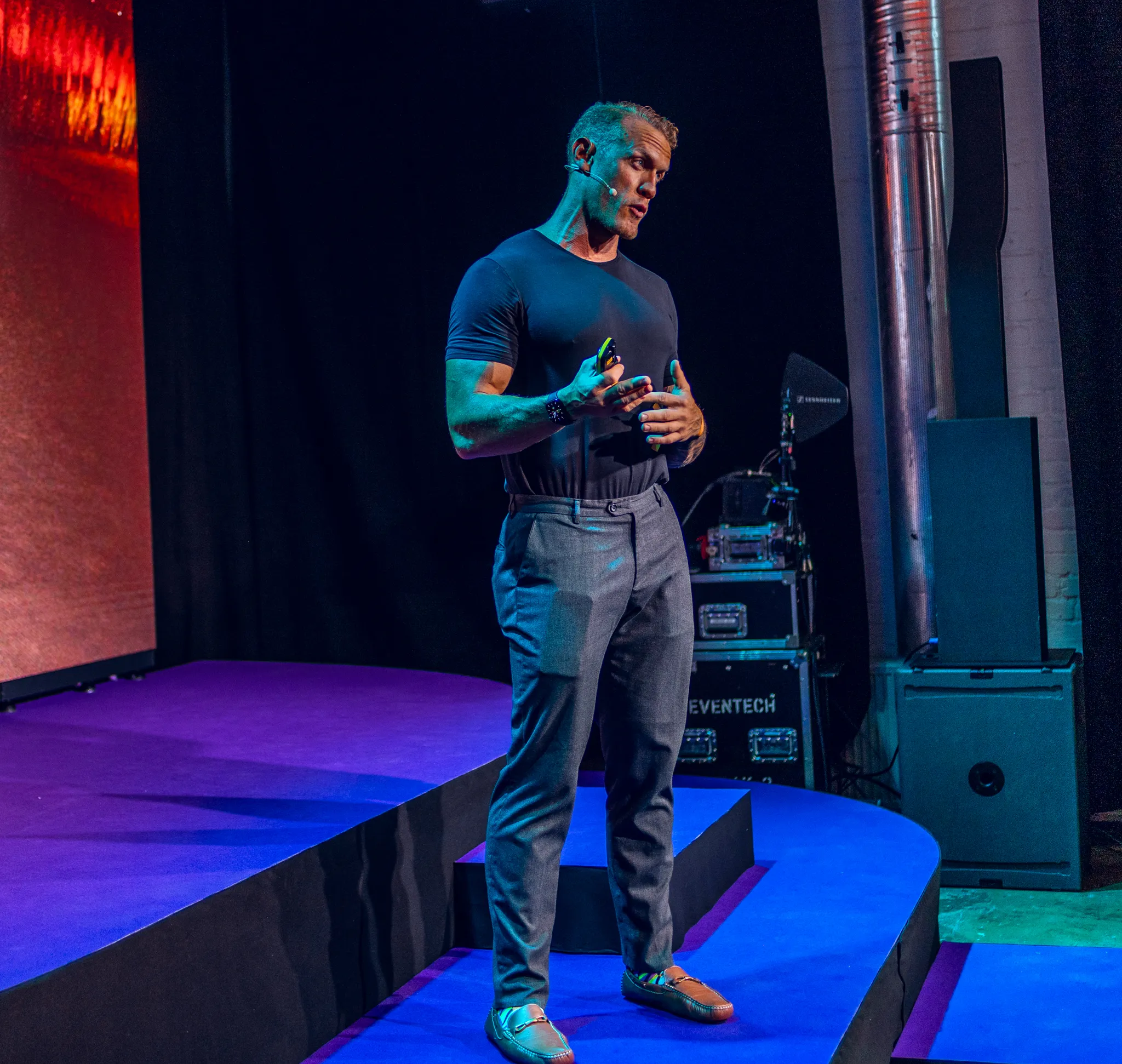
John Harper at Biohacker Summit 2024 Helsinki
Looking back now, climbing close to 40, looking potentially at having children soon. I want to tell that younger self of me to calm down, to focus more on recovery, and know that it's okay to take a few steps back, to take a few steps forward.
— John Harper, Biohacker Summit 2024 Helsinki
The practical lesson is to start with a goal and ask whether the tool has evidence for it. Harper's experience may explain why he developed a portable device for athletes, but it does not establish a performance or recovery benefit for everyone, and neither do the papers cited here.
He framed red light as an everyday health habit:
What I want to encourage people with using red light is that it is like a multivitamin. It's like clean water, healthy food, regular sleep, exercise…
— John Harper, Biohacker Summit 2024 Helsinki
That analogy describes his approach rather than a clinical finding. The papers cited here do not test red light as a general daily habit.
Which red light therapy benefits have evidence, and where are claims still uncertain?
A 2021 clinical review found a reasonable body of trial evidence for low-energy red or near-infrared light in skin rejuvenation, acne, hair loss and body contouring. It also noted small patient groups, methodological flaws and industry funding, and said it was unclear whether LED sources match other light sources. Evidence for a category does not validate every product.
For acne, a systematic review and meta-analysis of red light therapy for moderate-to-severe acne covering 13 randomised trials involving 422 participants found no statistically significant superiority for red light therapy over conventional treatments in the outcomes assessed. Adverse events were generally mild or absent. Individuals may still benefit, but red light has not been shown to be clearly better.
In wound healing, a 2025 study of red-light LED therapy and wound regeneration reported changes in collagen-related markers, VEGF and an inflammatory marker after 630-nanometre red-light treatment. It used cultured cells and mice with standardised wounds, so it does not show that consumer devices heal human wounds. It also identifies treatment duration and distance as variables affecting results.
Eye claims need particular caution. A 2025 review of red light therapy in ophthalmology discusses research into myopia, glaucoma, age-related macular degeneration and dry eye, and notes unresolved questions about dosing, safety and standardisation. It considers possible future applications. It gives no grounds to self-treat eye disease.
The strongest case is for specific studied uses. Sweeping promises about energy, recovery, pain, ageing or general health have far less behind them, and even for studied uses, parameters and evidence quality still matter.
Wavelength, dose and device: what to check before buying
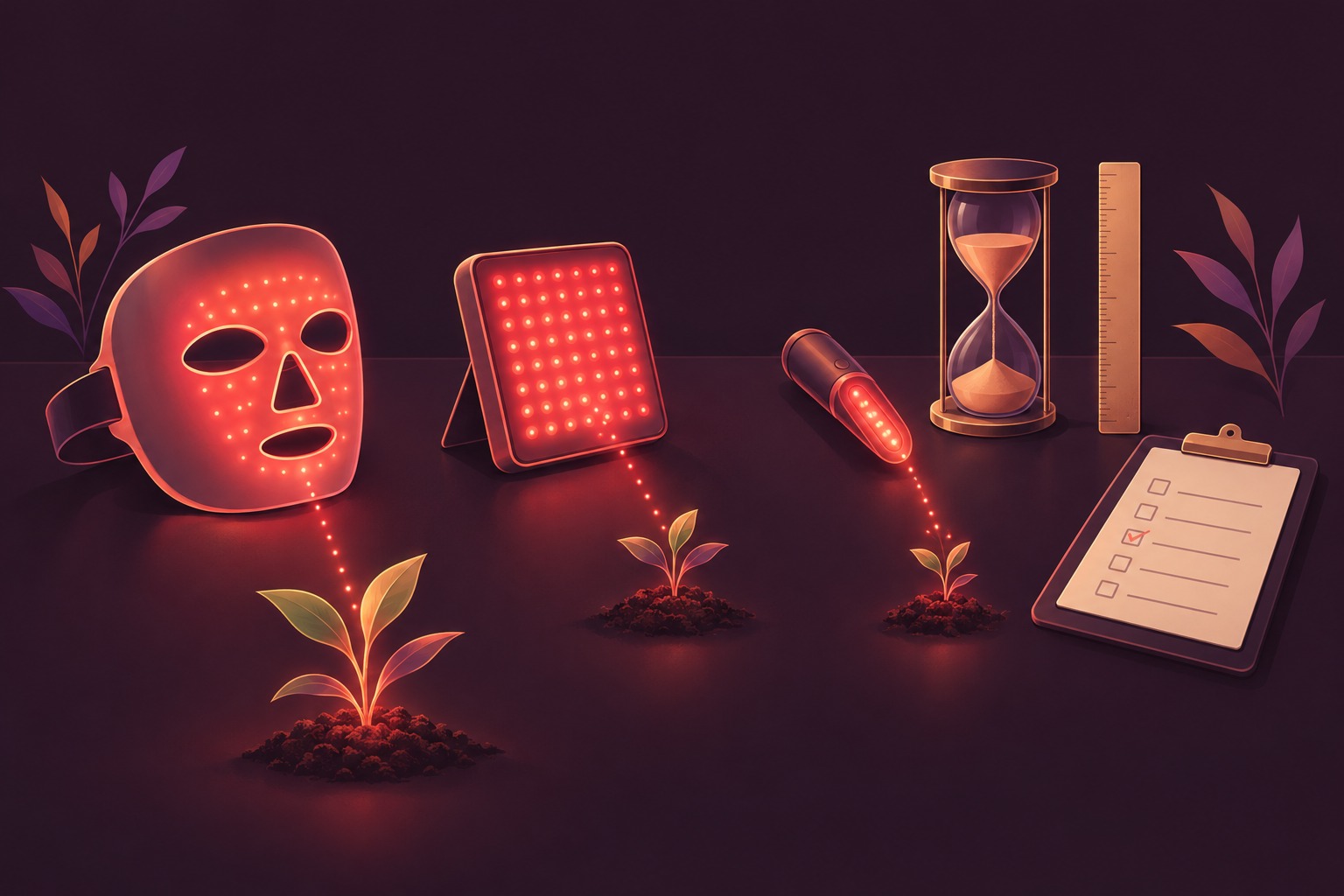
Different red light devices vary in distance, duration and design, which is why each one needs checking against its intended use.
A device that glows red may not match any clinical protocol. Check:
- Intended use. Is it aimed at a specific skin or health concern, or does it make broad claims? Evidence for one use does not automatically apply to another.
- Light specifications. Is it red, near-infrared or both, and are the wavelengths identified? The cited literature does not establish one ideal wavelength for every purpose.
- Treatment instructions. Distance and duration affect exposure. The wound study tested different times and distances, and the clinical review calls reproducibility a challenge. Good instructions make consistent use possible.
- Evidence for the device. General photobiomodulation research does not prove a particular mask or panel has been tested. A 2026 product guide to red-light therapy discusses evidence-based photobiomodulation masks and relevant US Food and Drug Administration channels; it does not validate every device category.
- Safety and oversight. Look for regulatory clearance or authorisation for the stated use where it is sold. That tells you more than testimonials or a vague "medical grade" label.
Without clear parameters and an intended use, suitability is hard to judge. High price, a large treatment area and attractive specifications do not demonstrate effectiveness.
How to use red light therapy safely and realistically
Start with a specific goal and compare the device's stated use and instructions with research on the same purpose. Evidence for skin rejuvenation, for example, should not be assumed to support athletic recovery. Follow the instructions instead of assuming more light works better: protocols vary, the wound study found that duration and distance affect results, and the papers give no universal home schedule.
To judge results for a visible skin concern, track the same features consistently instead of relying on daily impressions. For pain or recovery, consider what else has changed. Harper's account offers a perspective on recovery, not a controlled test of a device.
Read the eye-safety instructions that come with a device. The ophthalmology review calls dosing and safety open questions for eye use, so it offers no basis for self-treating eye conditions. The acne review found adverse events generally mild or absent, but that finding covers the trials it assessed, not every home device.
For wider conversations on health and technology, see HOLOLIFE Summit 2026 in Amsterdam, 14–15 November 2026.
When to seek medical advice instead of relying on a light device
A light device cannot diagnose pain, a skin change or a wound. None of the cited papers tests a consumer device as a substitute for clinical assessment: the wound study used cultured cells and mice, and the ophthalmology review leaves dosing and safety unresolved. A clinician can identify causes of acne or hair loss, discuss established options alongside light therapy, and advise whether it suits a condition or could interfere with other care. Harper's account supports taking recovery seriously. It does not support replacing assessment or treatment with a device.
FAQ
Does red light therapy actually work?
A clinical review finds a role for it in specific applications, including skin rejuvenation, acne, hair loss and body contouring. Evidence varies by use, and category findings do not prove every device works.
What conditions is red light therapy used for?
It is marketed and studied for skin rejuvenation, acne, hair loss, wound healing and some forms of pain or recovery. Evidence is more established for some skin applications than for broader athletic-performance claims, so each use needs its own evidence.
How can you tell whether a red light therapy device is effective?
Check its intended use, light specifications and instructions, and look for evidence for that device and purpose. Duration and distance matter because protocols vary. Regulatory status is worth checking but does not prove every advertised result.
What are the advantages of red light therapy?
The acne review found adverse events generally mild or absent, and the clinical review supports certain low-energy applications, but neither establishes the safety of every device or protocol. Follow instructions, take eye-safety guidance seriously, and seek professional advice for eye conditions, diagnosed illness or persistent symptoms.
Sources
- Photobiomodulation: The Clinical Applications of Low-Level Light Therapy
- Application of red light therapy for moderate-to-severe acne vulgaris: A systematic review and meta-analysis
- Illuminating eye care: the promise and future of red light therapy in ophthalmology
- Red-light LED therapy promotes wound regeneration by upregulating COL1A1, COL2A1, VEGF and reducing IL-1β for anti-inflammation
- What to Look for in Red Light Therapy: A Product Guide Backed by Science
- Talk: "Red Light Therapy for Optimal Performance & Recovery", John Harper, Biohacker Summit 2024 Helsinki
This article is for general information and is not medical advice.
In this story

Comments
Loading comments…