Biohacker Summit 2023 Amsterdam
Siberian Shamanism As A Living Bridge Between Deep Time And Modern Thought
By Teemu Arina · · Updated

At Biohacker Summit 2023 Amsterdam, German Popov Mapped An Ancient Cosmology That Still Refuses To Fade
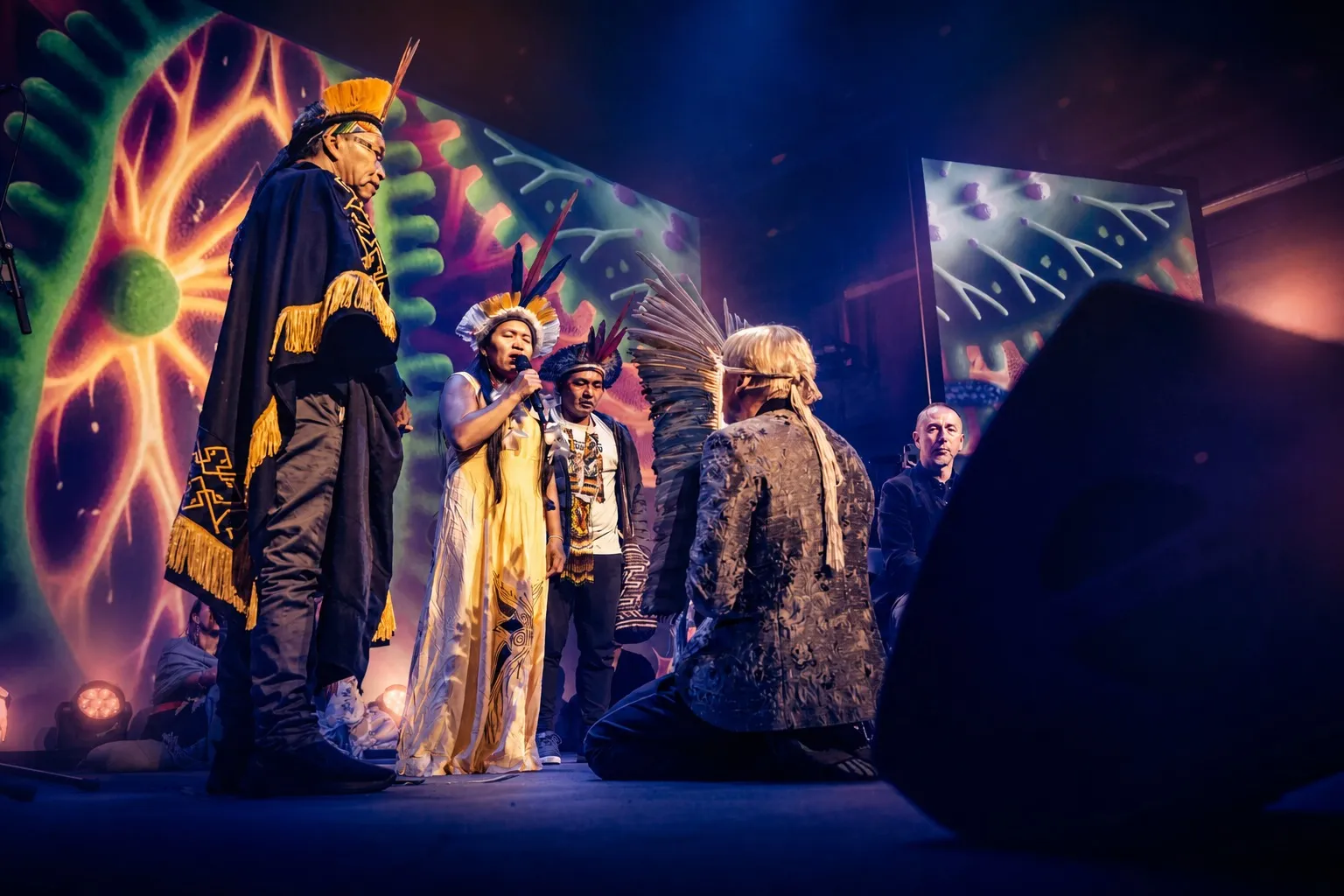
On Saturday, 14 October 2023, at Biohacker Summit 2023 Amsterdam in the Netherlands, the musician, composer, sound artist and researcher German Popov offered something rarer than a lecture and more charged than a performance. In his presentation, Siberian Shamanism: Mirror Of Archaism & Modernity, he opened with ritual gesture rather than abstract argument, showing instruments from Siberia and offering the smoke of mountainous juniper, used in ceremonial smudging. It was an entrance into a worldview in which sound, matter, spirit and symbol are not separate provinces, but parts of one continuous terrain.
Popov, known also under the stage name OMFO, has long worked at the border between ethnographic inquiry and artistic practice. His talk reflected that dual allegiance. It was not merely an anthropological overview of Siberian shamanism, nor a romantic invocation of a lost world. It was an attempt to show how an ancient spiritual technology, forged in the severe ecologies of Siberia, continued to hold explanatory and imaginative force in a modern age obsessed with consciousness, systems and hidden connectivity.
A Spirituality Rooted In Nature, Cosmos And Survival
Popov argued that shamanic spirituality was among the most inclusive forms of religious experience, accepting multiple modes of revelation as self-evident reality. At its heart, he said, lay faith in the sacred character of nature, the charged meaning of spatial directions, the use of secret ritual objects, and the notion of a supreme primordial force embedded in the fecundity of the cosmos.
Siberia, he suggested, preserved these traditions longer than many other regions for historical reasons. Isolation, continuity and the layered interactions of peoples across millennia allowed old forms to survive where elsewhere they were erased, absorbed or institutionalised beyond recognition. The result was not a fossil, but a living archive.
He traced the roots of this world back to the Upper Palaeolithic, when ancient Siberia acted as a formative centre for Asian coastal, proto-Americanoid and continental cultures. That deep history, he said, helped explain why Native Siberian and Native American traditions often shared notable commonalities. Later waves of migration in the Bronze Age, involving proto-Aryan, Finno-Ugric and East Asian groups, further enriched Siberia’s mythologies and ritual systems, producing a syncretic folklore with echoes across Eurasia and beyond.
The Shaman As A Figure Of Duty, Not Mystique
One of Popov’s most arresting clarifications was social rather than mystical. “A shaman belongs to a distinct social caste that is located higher than healers and fortune tellers,” he said. Communication with spirits, in this account, was not the exclusive privilege of shamans. What distinguished them was obligation. “They are the ones who carry out the duty of traveling between worlds.”
That distinction mattered. In popular western imagination, the shaman is often reduced to healer, visionary or exotic intermediary. Popov restored a more precise Siberian understanding: the shaman as a specialist entrusted with movement across cosmological zones, not for spectacle, but for communal need, healing and ritual efficacy.
The World Tree And The Three-Tier Universe
At the centre of this cosmology stood the Axis Mundi, or World Tree, the great vertical structure connecting all levels of existence. “The World Tree is a universal mythological archetype of the cosmic tree that unites all spheres of the universe,” Popov said. “Its branches correspond to the sky, the trunk to the earthly world, and the roots to the underworld.”
From this image emerged the basic architecture of Siberian shamanic thought: a three-tier universe composed of upper, middle and lower regions. The shaman’s ritual journey was a traversal of this vertical map. These journeys were not ends in themselves. They were techniques of mediation, deployed in rites of healing, supplication and restoration.
The elegance of the structure was striking. It offered not merely a mythology, but a model of relation, one in which heaven, earth and underworld remained connected through a living axis, and where human consciousness could, under disciplined ritual conditions, move among them.
Illness, Inheritance And Calling
Popov described three principal paths by which one became a shaman. The first was hereditary descent, often from grandparent to grandchild, and considered the strongest line of transmission. The second was the call, often described in ethnographic literature as “shamanic illness”, a period of severe affliction through which spirits selected the initiate. The third, more rare in traditional Siberian societies, was personal wish.
Here, suffering was not merely biographical accident. It could become election. The illness did not simply break the future shaman. It marked, tested and transformed them. In a modern culture that tends to pathologise all rupture, this older framework proposed something harder and more unsettling: that crisis might also be initiation.
Yula, Sut And A Language For The Soul
Popov turned next to terminology from Altai, a region of immense linguistic and cultural significance, to illuminate the inner mechanics of shamanic anthropology. The term yula, he explained, could be roughly translated as the double, but also carried meanings such as soul, shadow, breath, image and spectre. It named something more fluid than the western idea of a unitary self.
Another term, sut, described an individual life force of cosmic origin. “Sut is a vital energy of cosmic origin, saturated with the radiance of the stars, the moon, and the sun,” Popov said. “It is often allegorically depicted as a golden thread coming from the sky.”
It was a beautiful image, but also a serious metaphysical claim. Life, in this system, was not self-enclosed. It descended, connected, radiated. The human being was not an isolated organism, but a point of contact between celestial and earthly energies.
Spirits, Drums And The Mechanics Of Trance
In Popov’s account, the shaman never acted alone. The efficacy of ritual depended on tutelary spirits, the companion entities through whom the shaman’s work was carried out. These spirits were not decorative additions to belief. They were operational presences, constitutive of the act itself.
The drum, meanwhile, was the central ritual instrument, not merely for rhythm but for transport. Permission to possess it, Popov said, was sanctioned by a higher deity. Its making and “resuscitation” could last several days, undertaken before a gathered community. Its anthropomorphic holder symbolised the chief spirit; the animal skin from which it was made represented a patron spirit; other assisting entities were drawn upon its surface. In total, the drum became a map, a body and a vehicle at once.
This was one of the lecture’s quiet revelations: ritual technology in Siberian shamanism was intricate, symbolic and highly structured. Nothing about it was casual. Every component was embedded in cosmological logic.
Fly Agaric And The Risk Of Altered Vision
Popov also addressed the use of fly agaric mushrooms among Indigenous communities in Chukotka and Kamchatka as a means of inducing trance and visions. The subject, often sensationalised, was handled as part of a broader ritual ecology. Fly agaric contained psychoactive compounds, he noted, but also real danger. In some traditions, to lessen toxicity, initiates might drink the urine of an elder shaman who had already metabolised the substance and developed tolerance.
It was a reminder that altered states, in these traditions, were not recreational. They were bounded by knowledge, hierarchy, embodied risk and communal control. Modern audiences, eager for shortcuts to transcendence, were confronted instead with discipline, danger and inherited technique.
Where Archaism Met Quantum Speculation
The most provocative turn in Popov’s presentation came when he linked shamanic ideas to concepts in modern physics. He did not claim equivalence, but drew suggestive parallels. Quantum mechanics, he said, raised questions about consciousness, observation and the structure of reality that resonated with certain shamanic intuitions.
“Shamanism emphasizes the power of consciousness and the ability of spiritual practitioners to interact with the physical world through their intentions and beliefs,” he said. He went further: “Quantum mechanics and shamanism share intriguing similarities in their exploration of the fundamental nature of reality, the interconnectedness of all things, and the role of consciousness in shaping our experiences.”
The analogy rested particularly on two ideas. The first was the observer effect, in which observation influences the behaviour of particles. The second was non-locality, where entities appear linked across distance in ways classical intuition struggles to explain. For Popov, these served as modern conceptual rhymes with older shamanic beliefs in intentional influence, spirit communication and movement beyond ordinary limits of space and time.
There were obvious risks in such comparisons. Physics is not mythology, and metaphor can quickly harden into pseudoscience. Yet Popov’s larger point was less that shamanism anticipated quantum theory than that modernity, after centuries of reduction, had begun to rediscover strangeness in the fabric of reality itself.
From The Arctic To Shinto
Popov also suggested that Siberian shamanism belonged to a broader trans-Eurasian field of related traditions. Japanese Shinto, he argued, could be understood as an institutionalised form of the same archaic matrix. Ancestor worship, spirit communication, nature reverence, sacred sites and ritual structure all pointed, in his view, to deep typological affinities.
This was not a crude flattening of difference, but an invitation to see continuities where modern classification often sees sealed civilisations. It underscored his central claim that Siberian shamanism was not an isolated curiosity at the edge of the world, but part of a vast and enduring human attempt to negotiate the seen and unseen.
The Mouth Drum And The Persistence Of Tradition
Popov ended where he began, with sound. Referring to the mouth harp used in Upper Siberia, in the Republic of Sakha or Yakutia, he noted that it was often called a “mouth drum” because shamans used it in Kamlani, the ritual act of shamanic performance. The closing gesture returned the audience from theory to vibration, from comparative cosmology to the intimate physics of breath and resonance.
His final insistence was simple: this tradition was still alive. Shamanic illness, he said, remained a real occurrence in traditional tribal societies of Arctic and subarctic Siberia. The old pathways had not disappeared. They endured, though altered, threatened and often misunderstood.
In the end, Siberian Shamanism: Mirror Of Archaism & Modernity was not an argument for credulity. It was an argument against condescension. German Popov, speaking at Biohacker Summit 2023 Amsterdam, asked his audience to take seriously a system of thought in which consciousness, cosmos, suffering and ritual remained inseparable. In an age hungry for optimisation yet uncertain of meaning, that challenge landed with unusual force.
Frequently asked questions
How did German Popov open the session?
With ritual gesture rather than abstract argument, showing instruments from Siberia and beyond. The musician, composer, sound artist and researcher offered something rarer than a lecture and more charged than a performance.
What distinguishes a shaman from a healer?
Obligation rather than access. A shaman belongs to a distinct social caste that is located higher than healers and fortune tellers, Popov said. Communication with spirits was not their exclusive privilege; what set them apart was carrying the duty of traveling between worlds.
What is the World Tree?
It is the Axis Mundi, the great vertical structure connecting all levels of existence. It is a universal mythological archetype of the cosmic tree that unites all spheres of the universe, Popov explained, with branches corresponding to the sky, the trunk to the earthly world and the roots to the underworld.
About the event
This recap is part of the Biohacker Summit 2023 Amsterdam series, recorded in Amsterdam on 14 and 15 October 2023. Read the summary of the whole event or join the next edition, HOLOLIFE Summit 2026 Amsterdam, on 14 and 15 November 2026.
In this story
Comments
Loading comments…