Biohacker Summit 2023 Amsterdam
Mysteries Of Radiation And Mental Health
By Teemu Arina · · Updated

At Biohacker Summit 2023 Amsterdam, Hagen Thiers Argued That Modern Electromagnetic Noise Was Quietly Reshaping Sleep, Mood, And Recovery
On Saturday, 14 October 2023, at Biohacker Summit 2023 Amsterdam in the Netherlands, entrepreneur and bio-hacker Hagen Thiers stepped onto the stage with a provocation that cut through the conference’s familiar language of optimization. Before supplements, before cold plunges, before sleep trackers and longevity routines, he suggested, there was a more basic question. What if the modern environment itself was injuring the body faster than wellness culture could repair it?
In his presentation, “Mysteries of Radiation & Mental Health,” Thiers framed man-made electromagnetic fields, or EMFs, not as an abstract technological byproduct but as a constant atmospheric pressure on human biology. His warning was direct: “I want to invite you to be conscious of what EMFs are doing to our brain, our moods, and our character.”
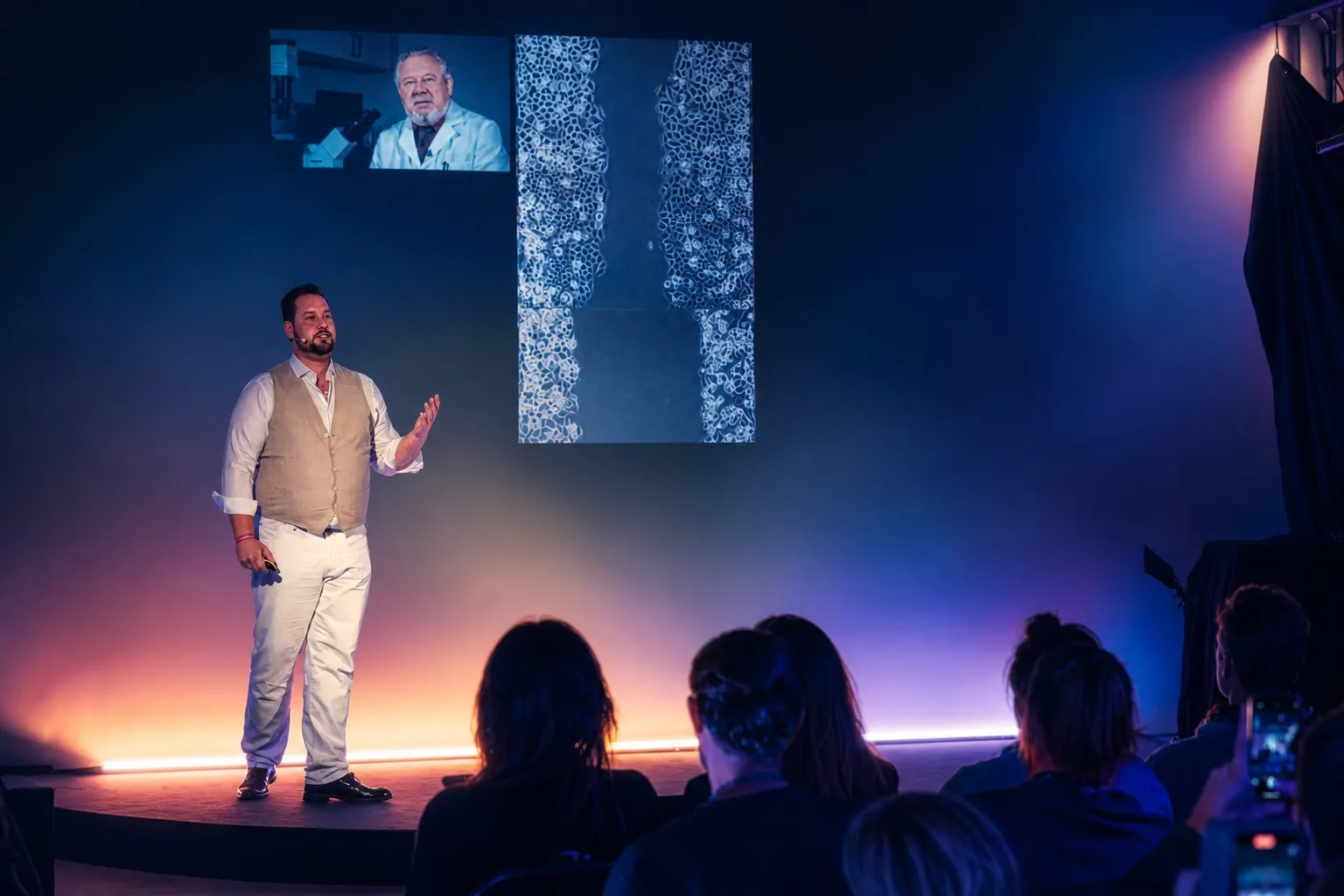
It was a talk that moved between philosophy, physics, sleep science and product-backed claims, but its emotional core was simpler than its technical vocabulary. In a world saturated by smart devices, base stations, Wi-Fi routers and always-on communication, Thiers urged the audience to think less about convenience and more about cost.
A World Filled With Invisible Noise
Thiers described modern life as an experiment in uninterrupted exposure. Phones, Bluetooth devices, Wi-Fi networks and cell towers, he argued, created a blanket of high-frequency signals around the body, a kind of invisible noise that the brain and cells were never designed to navigate.
To make the point vivid, he reached for an ordinary image: a mosquito in a bedroom. Small, almost intangible, but impossible to ignore once it entered the space. In his telling, EMFs functioned in a similar way, not necessarily through dramatic acute damage but through persistent disturbance.
He pointed to studies that, he said, linked proximity to cell towers with rising reports of headaches, insomnia, depression, memory loss and concentration difficulties. The pattern, as presented by Thiers, was stark. The nearer the bedroom was to a base station, the greater the reported burden of symptoms. The farther away, the lower the rates appeared to fall.
That argument landed not as a fringe aside, but as a central challenge to contemporary domestic life. Homes, Thiers implied, had become biologically contested spaces.
The Theory Of Decoherence
The most ambitious section of the talk came when Thiers introduced what he called the principle of decoherence. His argument rested on a mismatch of scale. Human biology, he said, communicates through extremely low-frequency processes, from cellular signaling in the millihertz range to brain waves operating below 10 hertz. By contrast, the devices surrounding modern humans transmit at vastly higher frequencies, in the megahertz and gigahertz ranges.
One gigahertz, he reminded the audience, is one billion times higher than one hertz.
For Thiers, this disparity mattered. Biological systems, he argued, depend on subtle internal communication, and the high-frequency activity generated by communications technology may interfere with that signaling. The body, in this framework, was not simply being exposed to energy. It was being interrupted.
“Speaking about consciousness also means evolving and having a new look at the different principles of how the world affects us,” he said.
His thesis was that non-thermal, man-made electromagnetic fields could produce biological decoherence by disrupting internal order. In practical terms, he suggested, the body’s own rhythms were forced to compete with a louder external environment.
Sleep, Stress, And The Hyperactive Brain
Where the talk became most immediate was in its discussion of sleep. Thiers cited research suggesting that mobile phone use before bed altered brain activity through the night, increasing stress responses and maintaining a higher level of brain metabolism when the brain should have been resting.
That claim spoke to a familiar contemporary condition: the exhausted body paired with the overstimulated mind.
According to Thiers, nighttime phone exposure, especially when used close to the head before sleep, could leave parts of the brain more active for hours. Sleep disorders, already widely reported in populations living near towers or immersed in device use, were therefore not incidental. They were evidence, he suggested, of a deeper environmental mismatch.
His advice was strikingly low-tech for a stage devoted to biohacking. Turn devices off. Switch phones to flight mode. Shut down Wi-Fi at night.
“We do not need to be twenty-four hours available, and choosing to turn off our devices allows our minds and bodies to truly rest and recover,” he said.
He described such steps as a “free biohack,” claiming that some people improved sleep efficiency by 10 to 15 percent within days simply by removing those stressors at night.
Depression, Dependence, And The Emotional Toll Of Constant Connection
Thiers also linked frequent phone use to depression and dependency, drawing on research he said showed a relationship between heavy mobile use and worsening mental health. He cast the smartphone not only as a communications tool but as a behavioral loop, one tied to endorphin release, compulsion and withdrawal.
This was not, in his formulation, only about radiation. It was also about habit.
The phone, always near, always lit, always demanding response, had become both stimulant and burden. To reduce exposure, then, was not only to lower a physical load but to reclaim a measure of psychological autonomy.
“Be conscious about what you are inviting into your home, as our brain waves and bodies are always reacting to these external disturbance fields,” he said.
It was one of the sharper lines of the session, partly because it moved beyond technical argument into a moral one. The smart home, in this view, was not automatically a healthier or more intelligent home. It was merely a more connected one.
Protection As A Foundational Form Of Biohacking
For Thiers, this issue sat beneath the glossy rhetoric of performance enhancement. If the body was under continuous stress from environmental exposure, then optimization without protection was incomplete.
“Your body is in a state of stress and injury while being exposed to man-made fields; it is hard to biohack your health if you are being injured at the same time,” he said.
That sentence captured the architecture of his broader message. The first step was not enhancement but subtraction. Reduce the burden. Limit the insult. Stop treating exposure as neutral.
He urged attendees to think carefully before filling homes with wireless appliances and connected gadgets, extending the logic of precaution to everything from routers to household devices marketed as smart conveniences.
The Promise And Controversy Of Depolarization
From there, the presentation shifted toward the technology Thiers is known for. As founder of Waveguard and the figure behind Qi Technologie, recognised by the European Association of Inventors as “Invention of the Year 2022,” he argued for a protective mechanism based on depolarization.
In his description, depolarization lowered electromagnetic field strength and altered wave spin by spreading radiation through liquid, making the signal less concentrated and more akin to natural, non-polarizing environmental fields such as those associated with the Earth or the sun. He said this process could reduce the field strength of 5G radiation by as much as 85 percent.
Thiers referenced studies involving mice, rats, and later human participants, asserting that depolarized radiation produced fewer stress responses than untreated exposure. He also cited a double-blind study with the Fraunhofer Institute and the University of Stuttgart that, he said, found measurable changes in brain-wave patterns, including improvements in the frontal theta area, among participants sleeping with active devices compared with sham devices.
It was the part of the talk where scientific claim and commercial proposition most clearly converged.
The 5G Healing Claim
Perhaps the most dramatic evidence presented by Thiers concerned wound healing in human skin cells. He said that in repeated 5G exposure experiments, cell healing that normally took 24 hours could be delayed to 96 hours without protection. With depolarization technology in place, he said, healing time dropped back to roughly 26 hours.
The claim was designed to shock, and it did. In a conference built around extending healthspan, the notion that a background technological condition might quadruple recovery time had obvious force.
Whether audience members accepted the evidence in full, the rhetorical effect was undeniable. Thiers was not arguing for a marginal tweak in well-being. He was arguing that the ambient infrastructure of digital life could alter how the body heals.
From Lapland To Amsterdam
Near the end of the session, Thiers turned briefly autobiographical. He described spending months in Finnish Lapland, traveling between remote wilderness cottages without electricity or tap water. Returning to reception, artificial light and the built technological environment, he said, brought on intense headaches.
That personal dislocation became, in his account, the beginning of his mission.
The anecdote mattered because it reframed the talk not simply as a technical presentation but as a story of re-sensitization. What most people had learned to ignore, he had come to experience as impossible to overlook.
By then, the audience had heard a case that was part warning, part philosophy, part intervention. Beneath it all ran a single appeal: attention.
To be conscious, in Thiers’ telling at Biohacker Summit 2023 Amsterdam, was not merely to meditate, track biomarkers or seek better performance. It was to notice the invisible architecture of modern life and ask what it was doing to the mind before asking how to improve it.
Frequently asked questions
What is Hagen Thiers's concern about modern environments?
That phones, Bluetooth devices, Wi-Fi networks and cell towers create a blanket of high-frequency signals the brain and cells were never designed to navigate. He made it vivid with an ordinary image: a mosquito in a bedroom, small and almost intangible, but impossible to ignore.
What does he mean by decoherence?
A mismatch of scale. Human biology communicates through extremely low-frequency processes, Thiers argued, from cellular signaling in the millihertz range to brain waves operating below 10 hertz, while the devices surrounding modern humans transmit at vastly higher frequencies.
What did he say about phones and sleep?
Thiers cited research suggesting mobile phone use before bed altered brain activity through the night, increasing stress responses and maintaining a higher level of brain metabolism when the brain should have been resting, which speaks to the exhausted body paired with the overstimulated mind.
About the event
This recap is part of the Biohacker Summit 2023 Amsterdam series, recorded in Amsterdam on 14 and 15 October 2023. Read the summary of the whole event or join the next edition, HOLOLIFE Summit 2026 Amsterdam, on 14 and 15 November 2026.
In this story
Comments
Loading comments…