News
ROS Reactive Oxidative Species: Why Balance Matters
By Teemu Arina ·

FOCUS KEYWORD: ros reactive oxidative species
ARTICLE:
ROS reactive oxidative species is a common search phrase, but in biology ROS stands for reactive oxygen species: oxygen-derived molecules made during normal life processes. They are not simply toxins to eliminate; their effects depend on their type, amount, location and duration, and on how well cells regulate them.
What are ROS reactive oxidative species?
Reactive oxygen species are a group of oxygen-derived molecules, including superoxide, hydrogen peroxide and hydroxyl radicals. Some are free radicals with an unpaired electron; others, such as hydrogen peroxide, are not. Cells generate ROS as part of ordinary metabolism and in response to signals like growth factors and immune activity. The body regulates their production and removal through antioxidant and redox systems. A review of ROS in cell signalling describes how hydrogen peroxide and superoxide can act as signalling agents, while excessive ROS formation can cause molecular damage (review of ROS in physiological signalling). Because ROS can take part in cellular communication, their biological role depends on regulation, not simply on their presence or absence.
When do ROS support normal cell function?
At controlled levels, ROS help cells respond to their environment by influencing signalling pathways involved in metabolism, stress responses, proliferation, and survival. A 2021 review describes how redox balance is tightly regulated within different parts of the cell, with effects depending on the source, amount, duration, and location of the molecules (review of ROS in different cellular locations).
In his HOLOLIFE Summit 2025 Tokyo talk, Masahisa Miwa distinguished ROS as metabolic products that are not all harmful, noting that the hydroxyl radical is more reactive and damaging than other ROS. It is more accurate to identify the specific ROS involved under particular conditions than to treat the group as interchangeable.
How does oxidative stress differ from ROS?
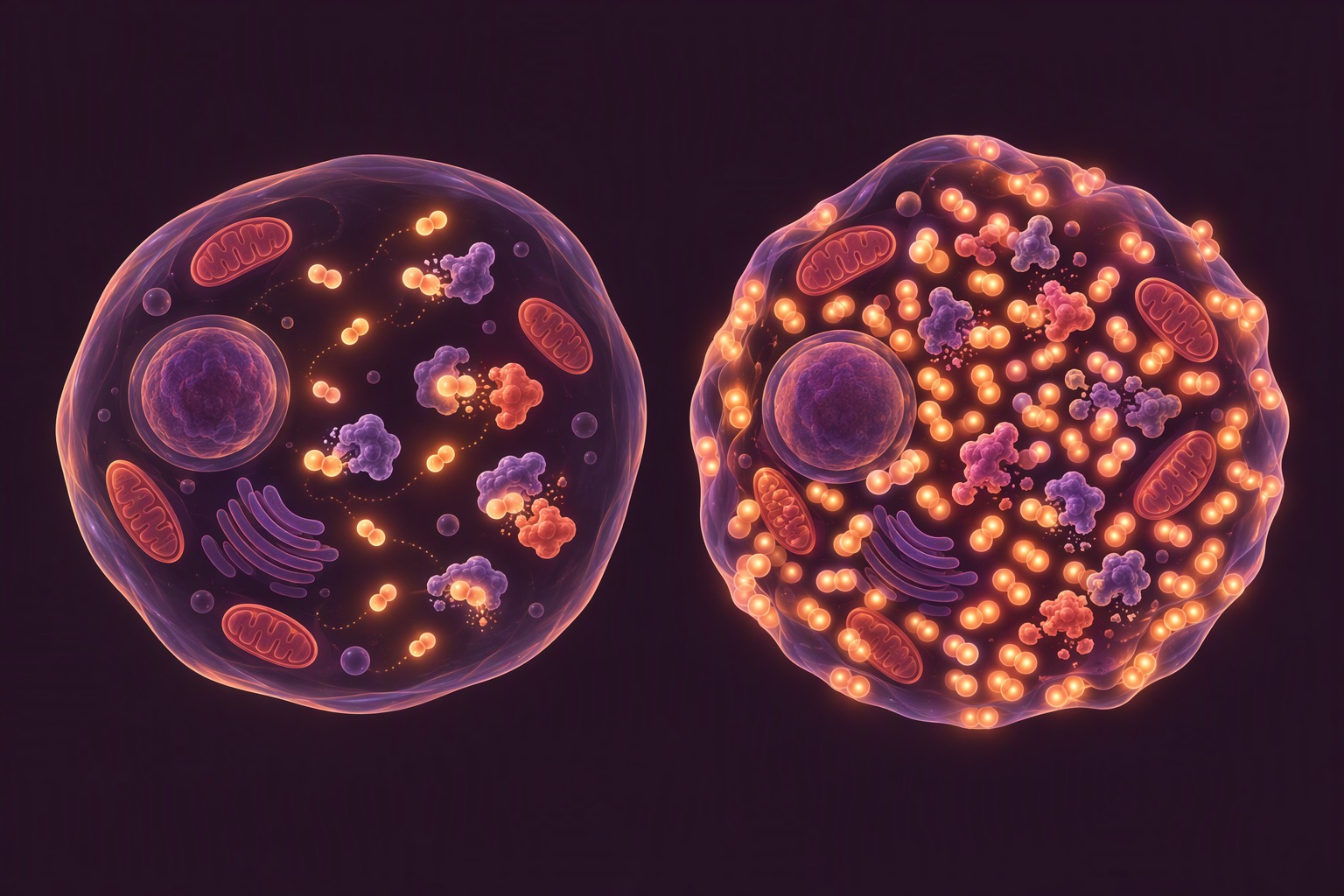
The illustration contrasts regulated ROS with an excess that overwhelms cellular defenses.
ROS are molecules; oxidative stress is a state of imbalance that occurs when oxidants exceed the cell’s capacity to manage them. In practical terms, oxidative stress means a mismatch between oxidant activity and the body’s protective systems, not simply "having ROS."
A review on cellular redox regulation describes oxidative stress as an excess of ROS over the cell’s ability to mount an antioxidant response, linking this imbalance to cellular damage and various disease states (review of ROS homeostasis and redox regulation). The paper also notes that ROS can act as important signalling molecules. Because oxidative stress does not specify which molecules are involved or where they are produced, broad claims about eliminating all ROS can be misleading.
What can oxidative injury affect?
When ROS production is excessive, oxidative injury can affect lipids, proteins, and DNA. Miwa described hydroxyl radicals as especially reactive and capable of damaging these cellular components. Damage occurs when production overwhelms antioxidant capacity, while other ROS generated by specialised enzymes facilitate normal signalling (review of ROS in cell signalling). The consequences depend on the source, amount, duration, and cellular location (review of ROS in different cellular locations). Redox biology aims to preserve the systems that maintain balance, not necessarily to remove every oxidant.
What the summit talks say about hydrogen and oxidative stress
At HOLOLIFE Summit 2025 Tokyo, Hikaru KOBAYASHI proposed a silicon-based agent that reacts with water in the intestines to generate hydrogen. He suggested this hydrogen could reduce hydroxyl radicals and keep oxidative stress below the body’s repair capacity. This is the speaker’s proposed mechanism, not an established conclusion.

Hikaru KOBAYASHI at HOLOLIFE Summit 2025 Tokyo
“The silicon waste agent reacts with water in our intestines, generating hydrogen continuously for twenty-four hours, which then reacts with harmful OH radicals to eliminate them.”
— Hikaru KOBAYASHI, HOLOLIFE Summit 2025 Tokyo
KOBAYASHI also discussed a proposed role for glutathione persulfide, though the provided information does not include clinical papers establishing the agent's effectiveness or safety for treating disease.
Masahisa Miwa, also speaking at HOLOLIFE Summit 2025 Tokyo, discussed inhaled HHO gas (atomic hydrogen and oxygen) as a way to influence oxidative stress by neutralising hydroxyl radicals.

Masahisa Miwa at HOLOLIFE Summit 2025 Tokyo
“When HHO gas is inhaled, it travels through our vital gateways, enters the bloodstream, and reaches every cell, enabling hydrogen to rapidly act on oxidative stress and support cellular function.”
— Masahisa Miwa, HOLOLIFE Summit 2025 Tokyo
These summit presentations offer hypotheses and practitioner interpretations, not established proof that hydrogen interventions improve health. Readers interested in the wider summit can find details of HOLOLIFE Summit 2027 Amsterdam, scheduled for 13–14 November 2027.
How light may influence the balance
In his HOLOLIFE Summit 2025 Europe talk, Matt Maruca argued that different wavelengths affect cells differently. He contrasted shorter-wavelength blue and ultraviolet light, which he said can stimulate ROS, with red and infrared light, which he associated with regenerative processes.
“Most modern LEDs flood us with blue light but lack healing near infrared; balanced light, including red and infrared, sustains our cell health.”
— Matt Maruca, HOLOLIFE Summit 2025 Europe
Maruca cautioned that excessive sun exposure can contribute to damage and noted that some red light can also generate ROS. The available research does not test Maruca’s specific claims; his comments are a perspective, not evidence that changing light sources will prevent injury.
What to take away about ROS and health
ROS reactive oxidative species are part of normal biology: cells regulate them, and some help relay signals. Problems arise when their production or persistence becomes unbalanced with cellular defences.
Superoxide, hydrogen peroxide and hydroxyl radicals have different roles. Controlled ROS signalling is normal, and oxidative stress is an imbalance rather than a single mechanism. Its effects depend on the molecules, tissues, and duration involved.
The summit talks describe proposed ways to influence this balance, not established health benefits.
FAQ
What does ROS stand for in biology?
ROS stands for reactive oxygen species, an umbrella term for oxygen-derived molecules like superoxide, hydrogen peroxide, and hydroxyl radicals.
Are reactive oxygen species always harmful?
No. At controlled levels, some ROS facilitate cellular signalling; they contribute to damage when excessive or poorly regulated.
What is the difference between ROS and oxidative stress?
ROS are molecules, whereas oxidative stress is the state of imbalance when oxidants exceed the cell's ability to manage them.
Can the body control reactive oxygen species?
Yes. Cells use antioxidant and redox systems to regulate ROS production and management within specific cellular compartments.
How do hydrogen and light relate to oxidative stress?
Summit speakers suggested hydrogen might influence hydroxyl radicals and light might affect ROS production, but these are practitioner claims rather than proven medical treatments.
Sources
- Reactive oxygen species (ROS) as pleiotropic physiological signalling agents
- Reactive oxygen species (ROS) homeostasis and redox regulation in cellular signaling
- Reactive oxygen species in cell signaling
- Reactive Oxygen Species: Not Omnipresent but Important in Many Locations
- Talk: “Si-Based Agent for Pharmaceuticals, Health, and Well-Being”, Hikaru KOBAYASHI, HOLOLIFE Summit 2025 Tokyo
- Talk: “Mitochondrial Benefits of Atomic Hydrogen (HHO)”, Masahisa Miwa, HOLOLIFE Summit 2025 Tokyo
- Talk: “Nuance in Light Therapy: Finding the Middle Way”, Matt Maruca, HOLOLIFE Summit 2025 Europe
This article is for general information and is not medical advice.
In this story

Comments
Loading comments…