News
Mastering Your Circadian Rhythm: Tools for Biological Timing
By Teemu Arina ·
The circadian rhythm is the body’s roughly 24-hour timing system, coordinating sleep, alertness and physiology. Circadian variation describes how these patterns change over the day and night, affecting measures such as heart rate and exercise performance.
Understanding the circadian rhythm definition
A circadian rhythm is an internal, approximately 24-hour pattern in biological activity. It involves a central clock in the brain and clocks in organs and other tissues, which coordinate when different functions are more or less active. A review of human and animal research describes this hierarchy and links its disruption with health consequences (review of circadian disruption).
Internal timing is not necessarily the same as clock time or a work or school schedule. Researchers can estimate it using dim-light melatonin onset (DLMO), the point in the evening when melatonin begins to rise under dim-light conditions. A small, preliminary study of late adolescents compared DLMO with sleep timing to examine circadian alignment and decision-making. It illustrates why internal timing and sleep timing are not interchangeable (study of circadian misalignment and decision-making).
Circadian variation can persist even when daily routines change. In a laboratory study of 12 recreationally active men, 10-kilometre running performance followed a 24-hour pattern, with the group’s best average performance in the early evening. This does not prescribe a training time for everyone. It shows that performance can vary with biological timing (study of circadian variation in running performance).
For a practical starting point, record sleep and wake times and energy highs and dips for a week or two. A diary cannot measure internal circadian phase, but it can reveal recurring patterns to discuss with a clinician if sleep or daytime functioning is persistently disrupted.
The role of the circadian body clock in daily energy
The circadian body clock coordinates daily changes; it does not predict exactly how energetic someone will feel. Sleep, activity and daily demands also matter. Specific measures, including heart rate and heart-rate variability, change with circadian timing and sleep stage.
In a controlled study, participants experienced repeated wake periods and naps in time isolation. Researchers found circadian rhythms in heart rate and heart-rate variability during wakefulness and several sleep stages. Deeper sleep was associated with greater parasympathetic influence, while REM sleep was associated with greater sympathetic influence (study of heart-rate variability across circadian timing and sleep stages). A single measurement taken at an arbitrary time may therefore not represent someone’s usual pattern.
In the running study, performance and body-temperature rhythms broadly tracked one another, with the fastest average time in the early evening. Because it involved a small group of men, it does not establish a universal training schedule. When comparing performance, record the activity time alongside the result.
Food timing may also influence peripheral clocks. A review of liver circadian rhythms discusses food’s effects on clocks in tissues such as the liver and considers meal timing as part of chrononutrition. Much of the evidence comes from experimental models, so it does not establish an ideal human meal schedule (review of liver circadian rhythms and chrononutrition).
Anthony DiClementi’s talk, "The Truth About Supplements" at Biohacker Summit 2016 Helsinki, presents supplements as secondary to broader health habits:
Supplements are a bridge, not an endpoint. They are a bridge to a bigger environmental change that needs to be made to help us get back to a spot where our body can take control of the healing process.
— Anthony DiClementi, Biohacker Summit 2016
The supplied material includes no session-page URL for the talk. Avoid treating a supplement, wearable reading or single performance test as a complete account of circadian health.
Using light to influence your circadian pattern
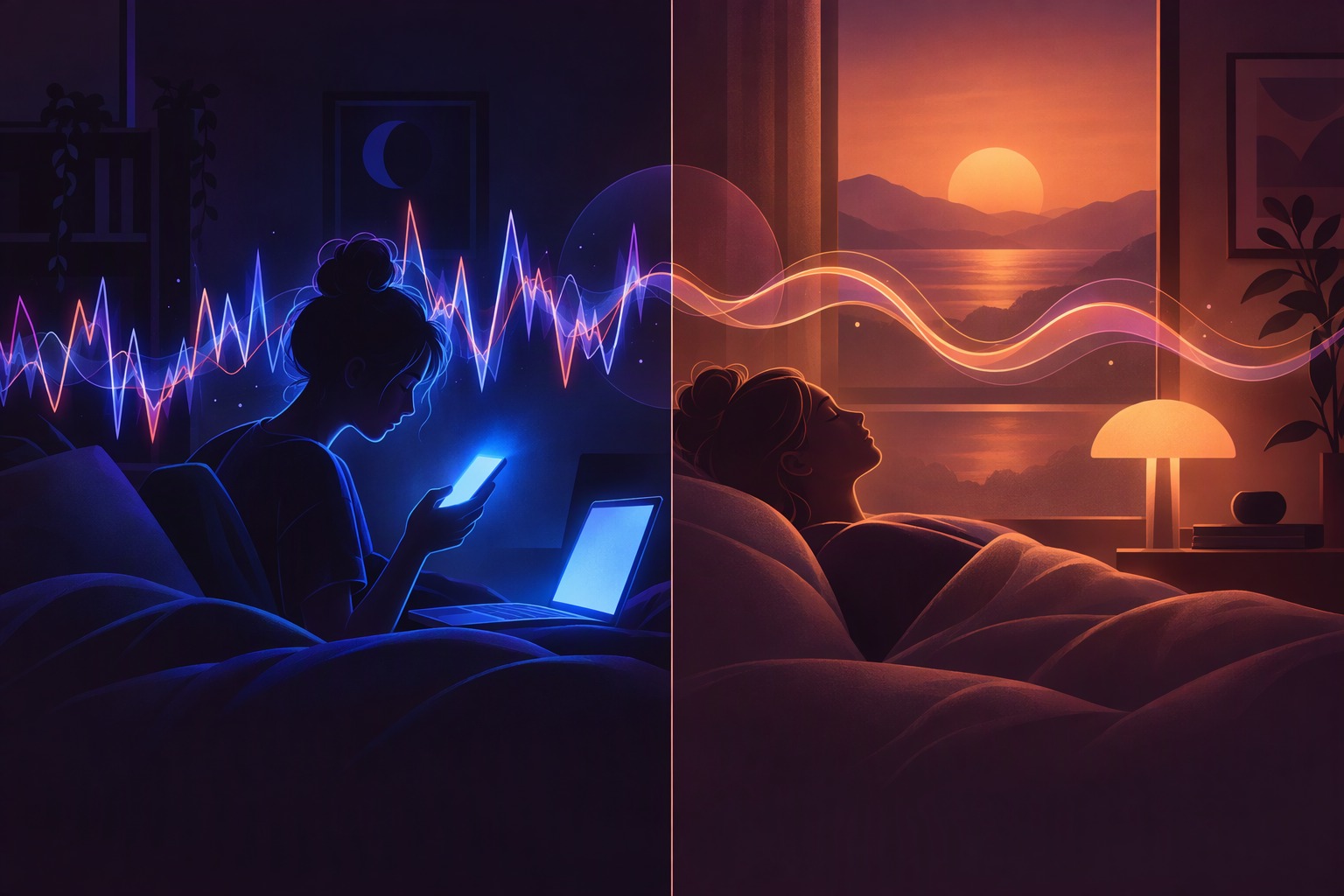
Different wavelengths of light can impact how the body's internal rhythm responds to its environment.
In "Photobiomodulation Therapy & Technologies for Home Use" at Biohacker Summit 2023 Amsterdam, Martin Junggebauer describes light as a biological signal that helps organise when the body switches functions on and off. DiClementi discusses blue light from phones, laptops, indoor lighting and televisions, saying it suppresses melatonin and can disrupt circadian rhythm.
We know the circadian rhythm, and we know how important it is to organize our body to switch on and off specific functions at the right time.
— Martin Junggebauer, Biohacker Summit 2023
If winding down is difficult, notice evening exposure to bright screens and indoor lighting. DiClementi’s talk supports paying attention to blue light but gives no universal cut-off time, screen setting or guaranteed sleep effect. Recording evening light habits alongside sleep timing can help identify a repeatable association.
More light is not always better. Junggebauer discusses colours used in photobiomodulation (PBM), which is distinct from ordinary environmental light exposure. His talk does not show that every wavelength, device or application time improves circadian alignment. Check what a light-based device is designed to do rather than assuming all light therapies work alike.
The impact of photobiomodulation on biological timing
Photobiomodulation uses selected wavelengths. Junggebauer’s talk discusses ultraviolet, blue, green and yellow as well as red and infrared light, and describes home-use devices as possible daily tools. These are the speaker’s claims and recommendations; no paper was supplied evaluating PBM as a way to shift circadian phase or establish an ideal schedule.
All life developed in light. As biohackers, we fully understand how important light is for our well-being and our biology, and how it organizes our body to switch on specific functions at the right time.
— Martin Junggebauer, Biohacker Summit 2023
The talk does not specify which colour to use at what hour to improve sleep timing, or whether evening use is suitable. Follow device instructions and seek qualified advice if a health condition or medication is involved, rather than building a circadian protocol from colour alone.
A practical PBM checklist is to identify the intended use, check the wavelength and instructions, and record timing and response. Feeling more alert after a session does not prove the body clock has shifted; the sources here do not establish that conclusion.
Vibration therapy and sleep quality
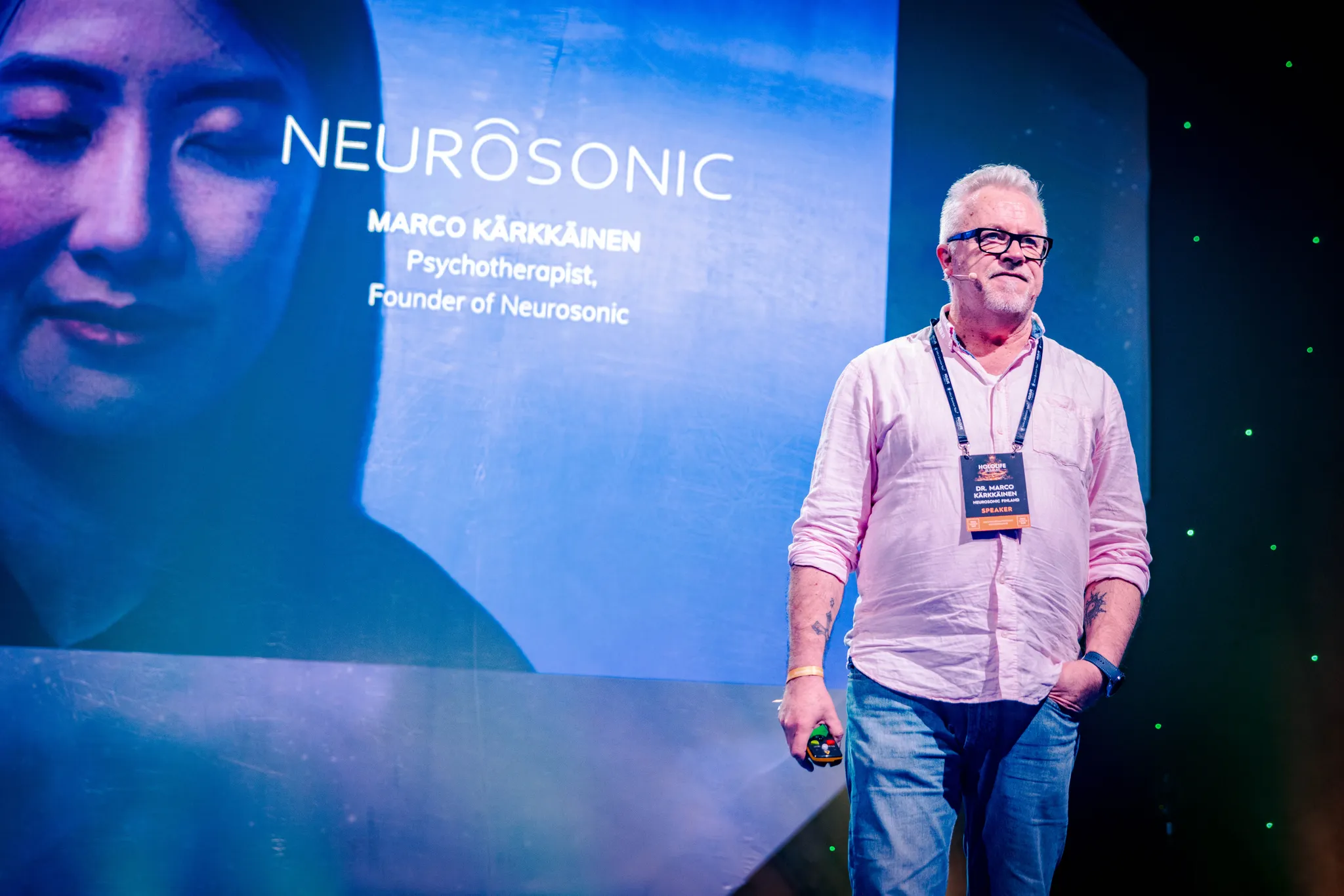
Marco Kärkkäinen’s talk, "Low-Frequency Vibration for Physical & Mental Recovery" at Biohacker Summit 2022 Helsinki, presents vibration as a way to support recovery and sleep quality. He says the nervous system may respond to coherent mechanical vibration and describes reduced stress and improved sleep as potential effects.

Marco Kärkkäinen at HOLOLIFE Summit 2025 Europe
When you provide coherent information to your nervous system, it adapts very fast. You can measure when your autonomic system starts to recover, and it happens in as little as two to five minutes.
— Marco Kärkkäinen, Biohacker Summit 2022
Kärkkäinen also proposes that vibration may reduce cortisol and support GABA function, which he connects with lower anxiety and better sleep. These are claims from his talk; no vibration-therapy paper was supplied for independent assessment. The talk gives no general schedule for session duration or frequency.
If exploring vibration, track a specific outcome, such as relaxation or bedtime routine, rather than assuming it resets circadian timing. Sleep quality and circadian phase are related but different: a calming response does not show that the internal clock has shifted.
Strategic supplement timing for rhythm support
The supplied talks do not show that any supplement-timing protocol optimises circadian rhythm. DiClementi discusses supplement quality and personalisation, and says supplements should support, not replace, broader changes; he gives no evidence-based schedule tied to circadian phases. Do not infer one from general discussion of energy or product lists.
A study in mice found circadian oscillations in serum iron, transferrin saturation and related processes, but does not establish a supplement schedule for people (study of circadian iron regulation in mice). The liver review discusses food timing and peripheral clocks but likewise does not establish that taking a particular supplement at a particular hour improves circadian alignment.
Record sleep timing, routines and supplement use, changing one factor at a time when assessing a response. Discuss timing and suitability with a healthcare professional if using supplements for a diagnosed deficiency or alongside medication. Supplements are not a substitute for investigating persistent sleep problems.
For readers interested in the wider biohacking community, HOLOLIFE Summit 2027 Amsterdam takes place on 13–14 November 2027.
FAQ
What is the circadian phase?
Circadian phase is a person’s position in their internal daily cycle. DLMO helps researchers estimate internal timing, while sleep and wake times describe behaviour; the two can be misaligned.
Are chronotypes real?
People differ in preferred or usual sleep timing, which researchers can compare with internal circadian markers. The small, preliminary decision-making study examined alignment among late adolescents, but does not establish what applies to everyone; a sleep diary can reveal patterns without assigning a medical label.
How can I fix my circadian rhythm?
Record sleep and wake times, evening light exposure and daytime energy for a week or two, then look for recurring patterns. DiClementi identifies blue light as a potential disruptor, and research links circadian timing with sleep-stage patterns and variation in some measures; seek professional guidance for persistent or disruptive sleep problems.
Do people with ADHD have a different circadian rhythm?
The talks and papers provided do not establish whether people with ADHD have a different circadian rhythm or support a specific ADHD-related light, vibration or supplement protocol. Anyone with ADHD struggling with sleep can track timing and discuss it with a qualified clinician.
Sources
- Circadian variation of heart rate variability across sleep stages
- Preliminary evidence that misalignment between sleep and circadian timing alters risk-taking preferences
- Evidence of a circadian variation in 10-km laboratory running time-trial performance
- Serum iron and transferrin saturation variation are circadian regulated in mice
- Health consequences of circadian disruption in humans and animal models
- Circadian rhythms of liver physiology and disease
- Talk: "The Truth About Supplements", Anthony DiClementi, Biohacker Summit 2016 Helsinki
- Talk: "Photobiomodulation Therapy & Technologies for Home Use", Martin Junggebauer, Biohacker Summit 2023 Amsterdam
- Talk: "Low-Frequency Vibration for Physical & Mental Recovery", Marco Kärkkäinen, Biohacker Summit 2022 Helsinki
This article is for general information and is not medical advice.
In this story

Comments
Loading comments…