Biohacker Summit 2024 Helsinki
Sasha Crespi Turned A Room Of Strangers Into A Heartbeat At Biohacker Summit
By Teemu Arina · · Updated
A Magic Show That Asked Its Audience To Stop Solving Life
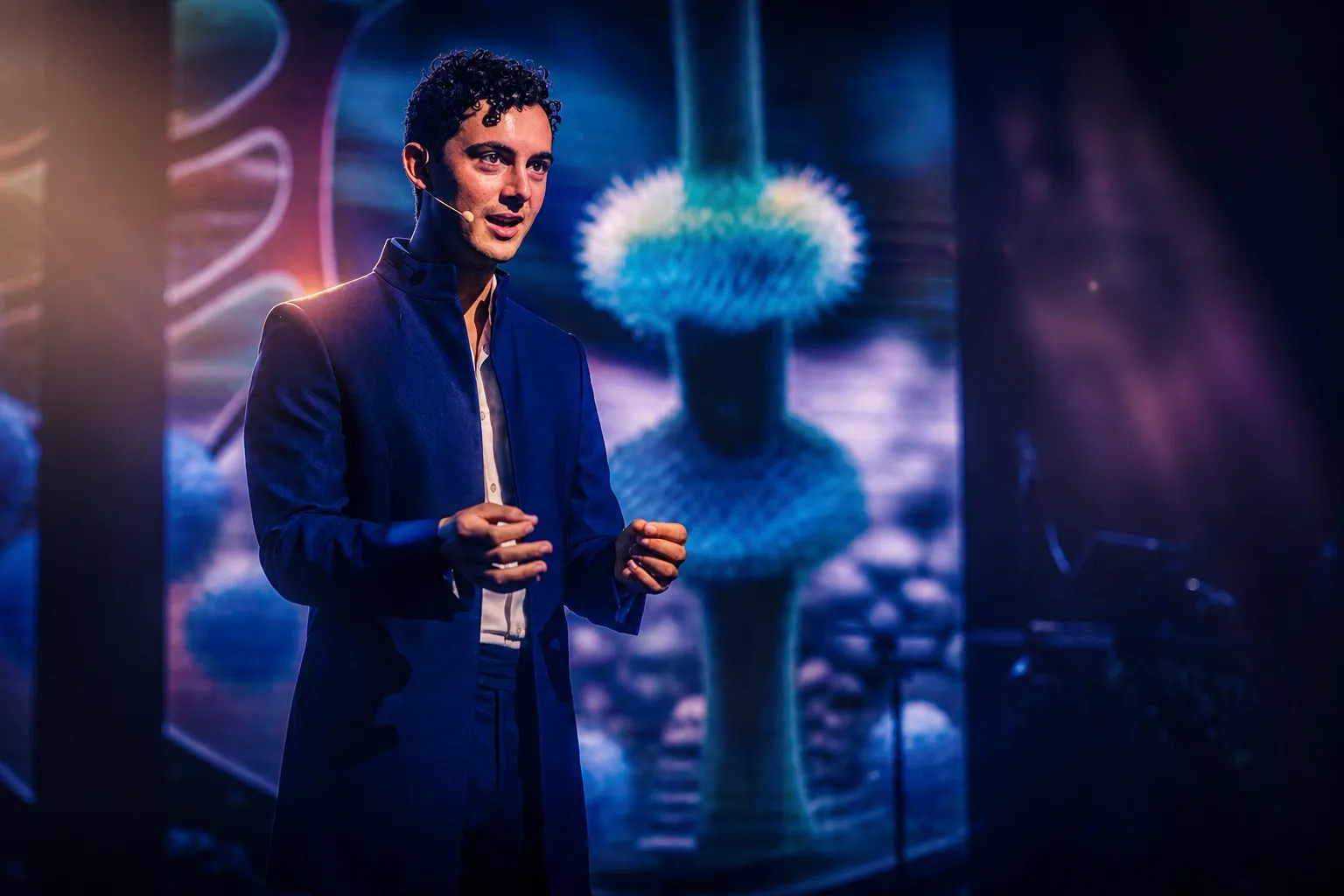
At the Biohacker Summit in Helsinki on Wednesday, 3 July 2024, Sasha Crespi did not begin with a trick so much as a proposition. The Persian-Italian magician, mentalist and ritual artist stood before the crowd and offered what he called "a miracle in connection". It was a bold promise, part performance and part invocation, and for the next stretch of time he pursued it with the confidence of a showman and the seriousness of a philosopher.
Crespi, whose work has long fused illusion with reflection, used his session, titled Magic Show, to push beyond spectacle. He asked the audience to empty their hands, clap, rub their fingernails together, feel the heat and friction between their fingers, and place a hand on the chest to locate the body’s simplest metronome: the heartbeat. Soon the room was tapping against legs and chairs, each person sounding out their own pulse before being guided toward something larger, a common rhythm, what Crespi called "perfect connection, perfect unison, a heart song."
The effect was quietly disarming. In a summit devoted to optimization, measurement and human potential, Crespi made a case for surrender.
The Philosophy Beneath The Illusion
Before borrowing a single ring, Crespi paused to frame the terms of the encounter. Life, he said, could be lived in one of two ways. It could be treated as a puzzle to be solved, an endless strain of analysis that tightened the mind. Or it could be met as mystery, with relaxation, release and trust.
"Don't try to figure out how the magic is done," he told the room. "You'll only get more tense."
It was more than stage patter. It was the thesis of the performance. Crespi’s magic was not merely there to astonish but to challenge the reflex that insists every experience must be conquered by explanation. In that sense, the trick was also a critique: of control, of skepticism as a posture, of the modern need to reduce wonder into mechanism before it has had time to work on us.
Eight Rings And A Visible Metaphor
Then came the object lesson.
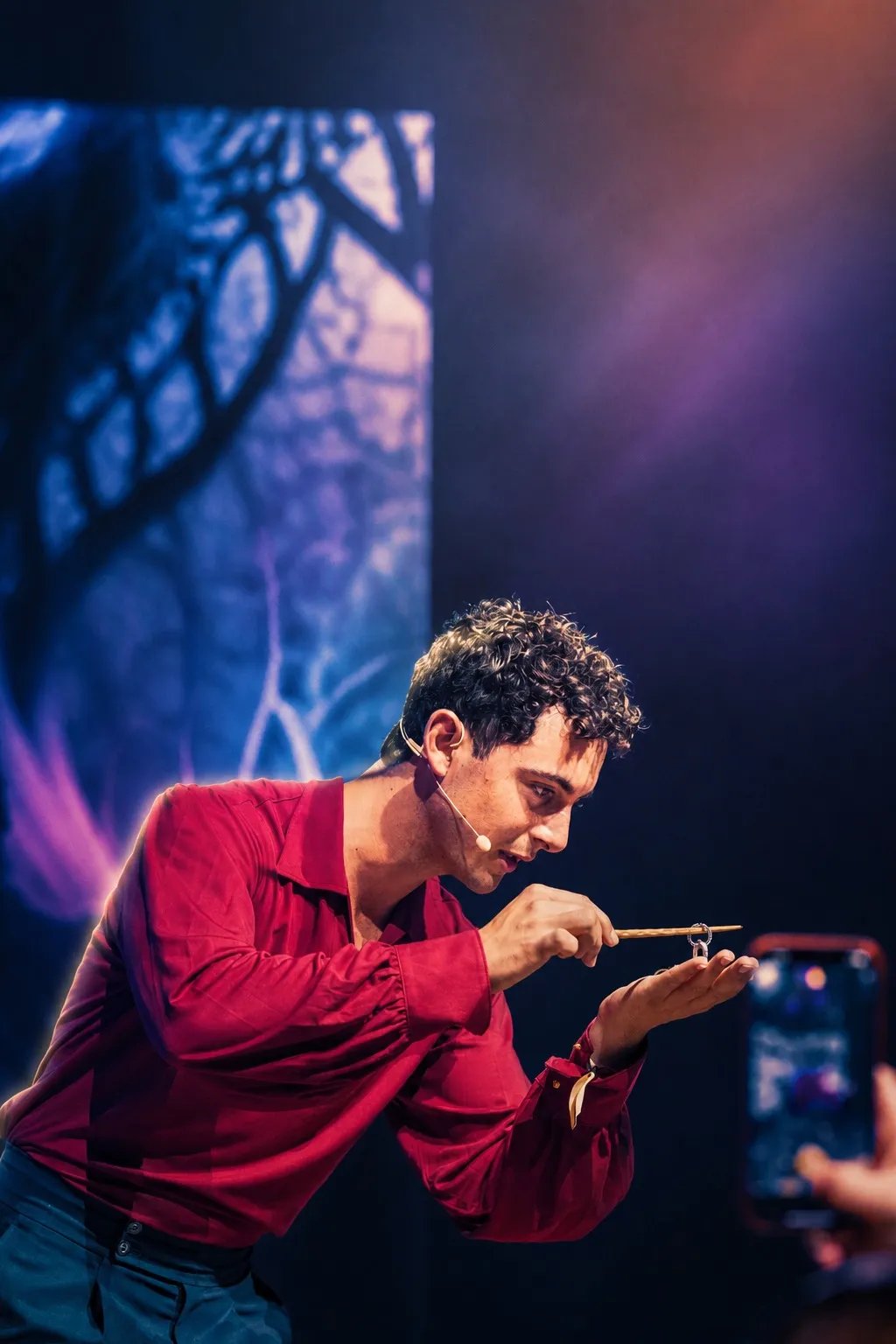
Crespi moved through the crowd collecting borrowed rings: a circular gold band, emotionally valuable pieces offered by strangers, and, in one of the performance’s more vivid details, a Chanel ring he jokingly selected for "cultural representation". The owners did not know one another. Their jewelry came from separate lives, separate histories, separate hands.
One by one, Crespi linked them.
He asked participants to inspect the result, to stand, verify, confirm. Was it real? Were the rings truly connected? The room answered back. Skeptics were invited in, not pushed away. Owners examined their own pieces and declared what they saw. The trick depended not only on Crespi’s hands but on collective witness.
By the time the linked objects became a chain of eight, the illusion had already exceeded itself. The rings were no longer just rings. They had become the performance’s central image: strangers made visibly inseparable. A set of independent circles transformed into a single structure.
"It certainly looks like we are separate, doesn't it?" Crespi said. "But everything and everyone is connected."
In another setting, such a line might have slipped into sentimentality. Here, because it was paired with tactile proof, however theatrical that proof may have been, it landed with unusual force. Crespi gave abstraction a body. He let people hold the metaphor in their own hands.
The Audience Became The Event
What distinguished the session was the way authorship seemed to spread across the room. This was not magic performed at an audience from a safe distance. It was magic built out of audience members, their pulses, their voices, their possessions, their willingness to participate in a temporary collective act of belief.
Again and again, Crespi returned to rhythm. The tapping of heartbeats on thighs and tables became a kind of communal percussion, first messy, then gathered, then briefly unified. He guided the crowd through gratitude affirmations that sounded less like applause lines than liturgy.
"I am grateful for this love. I am grateful for this life. I am grateful for this moment with each of you right now."
The phrase could have felt overrehearsed. Instead, inside the architecture of the performance, it functioned as a release valve. Gratitude was not introduced as self-help branding but as an instrument for synchrony, a shared utterance meant to dissolve self-consciousness and restore the room to itself.
Wonder As A Form Of Social Technology
There was an intriguing fit between Crespi and the Biohacker Summit. Biohacking often promises mastery over the body through data, interventions and systems. Crespi offered a different kind of human upgrade, one rooted in attention, embodiment and the ancient mechanics of ritual. He asked people not to optimize their separateness but to notice their interdependence.
His methods were simple, almost stubbornly analog: friction, breath, touch, repetition, eye contact, borrowed metal, spoken gratitude. Yet the result pointed toward something many high-tech spaces struggle to produce: genuine cohesion.
If there was a lesson in the room that day, it was that wonder can operate as a form of social technology. Not escapism, not naivety, but a way of reorganizing perception. Crespi’s performance suggested that when strangers are invited to act in concert, even briefly, the body understands something before the intellect catches up.
Walking Each Other Home
As the session drew to a close, Crespi returned to the heartbeat. Hands went back to chests. The tapping resumed. A room full of individuals once again became a rough, living instrument.
Then he left them with a line borrowed from Ram Dass, one that neatly completed the arc of the show: "We are all here to walk each other home."
It was an elegant ending, softened by a final joke that the eight ring-bearers, now symbolically linked, might have to do exactly that. But behind the laughter lay the deeper claim of the afternoon. Connection, Crespi seemed to argue, is not a metaphor we casually admire. It is the condition we keep forgetting and are forever being asked to remember.
At Biohacker Summit, Sasha Crespi’s Magic Show did not merely entertain. It staged a small rebellion against estrangement. For a few minutes in Helsinki, the mystery was not how the rings linked, but how readily a room of strangers allowed itself to become one pulse.
Frequently asked questions
What did Sasha Crespi promise the audience?
What he called a miracle in connection. The Persian-Italian magician, mentalist and ritual artist framed the performance less as a set of tricks than as an invitation, and pursued it with the confidence of a showman and the seriousness of a practitioner.
Why did he tell people not to figure out the trick?
Because of the philosophy underneath it. Life, he said, could be treated as a puzzle to be solved, an endless strain of analysis that tightens the mind, or met as mystery with relaxation and trust. Don't try to figure out how the magic is done, he told the room, you'll only get more tense.
What made the performance unusual for a biohacking event?
The audience became the event. Crespi collected borrowed rings from strangers, including a Chanel ring he jokingly picked for cultural representation, and built the act out of their pulses, voices and possessions. Biohacking promises mastery through data; he offered attention and embodiment.
About the event
This recap is part of the Biohacker Summit 2024 Helsinki series, recorded in Helsinki on 2 and 3 July 2024. Read the summary of the whole event or join the next edition, HOLOLIFE Summit 2026 Amsterdam, on 14 and 15 November 2026.
In this story
Comments
Loading comments…