News
Do Saunas Really Sweat Out Toxins? What the Evidence Says
By Teemu Arina ·

Do saunas really sweat out toxins? Partly. Sweat carries measurable arsenic, cadmium, lead and mercury, especially with higher exposure, but no one has shown that a sauna habit clears enough to change health outcomes. This article checks a Biohacker Summit 2022 infrared-sauna talk against the research.
Do saunas really sweat out toxins?
A systematic review of arsenic, cadmium, lead and mercury in sweat screened 122 records and included 24. In people with higher exposure or body burden, sweat concentrations generally exceeded those in plasma or urine, and skin excretion sometimes matched or surpassed daily urinary excretion:
- Arsenic skin excretion was severalfold higher in exposed people than unexposed controls.
- Cadmium was more concentrated in sweat than plasma.
- One case report saw mercury levels normalise with repeated saunas.
The reviewers said sweating "deserves consideration" for removing toxic elements but called for properly sized trials to establish safe, effective protocols. Populations, collection methods and concentrations varied widely. Missing is evidence that sessions lower body burden enough to matter for the average person.
What sweat contains besides water and salt
A study of a water-filtered infrared-A (wIRA) sauna tested sweat from 22 people for eight toxic elements (aluminium, arsenic, beryllium, cadmium, nickel, lead, titanium, mercury) and ten nutrients, including calcium, magnesium, iron, zinc, selenium and copper. Inorganic ion concentrations were higher than in exercise or wet-sauna sweat, and toxic elements were higher in women than men. Discharge of arsenic, beryllium, cadmium and nickel correlated with selenium and vanadium; the authors framed their results as basic information on nutrient replacement for sauna detox users, since heavy sweating removes minerals you want to keep.
A study comparing treadmill running with sitting in a sauna cabinet had 12 healthy university students sweat continuously for 20 minutes in each. Nickel, lead, copper and arsenic were significantly higher during exercise; mercury did not differ. The authors suggested dynamic exercise may remove heavy metals better than passive heat. The disagreement over which sweat is "richer" reflects a young field with small samples and differing methods.
How the body normally processes and removes waste
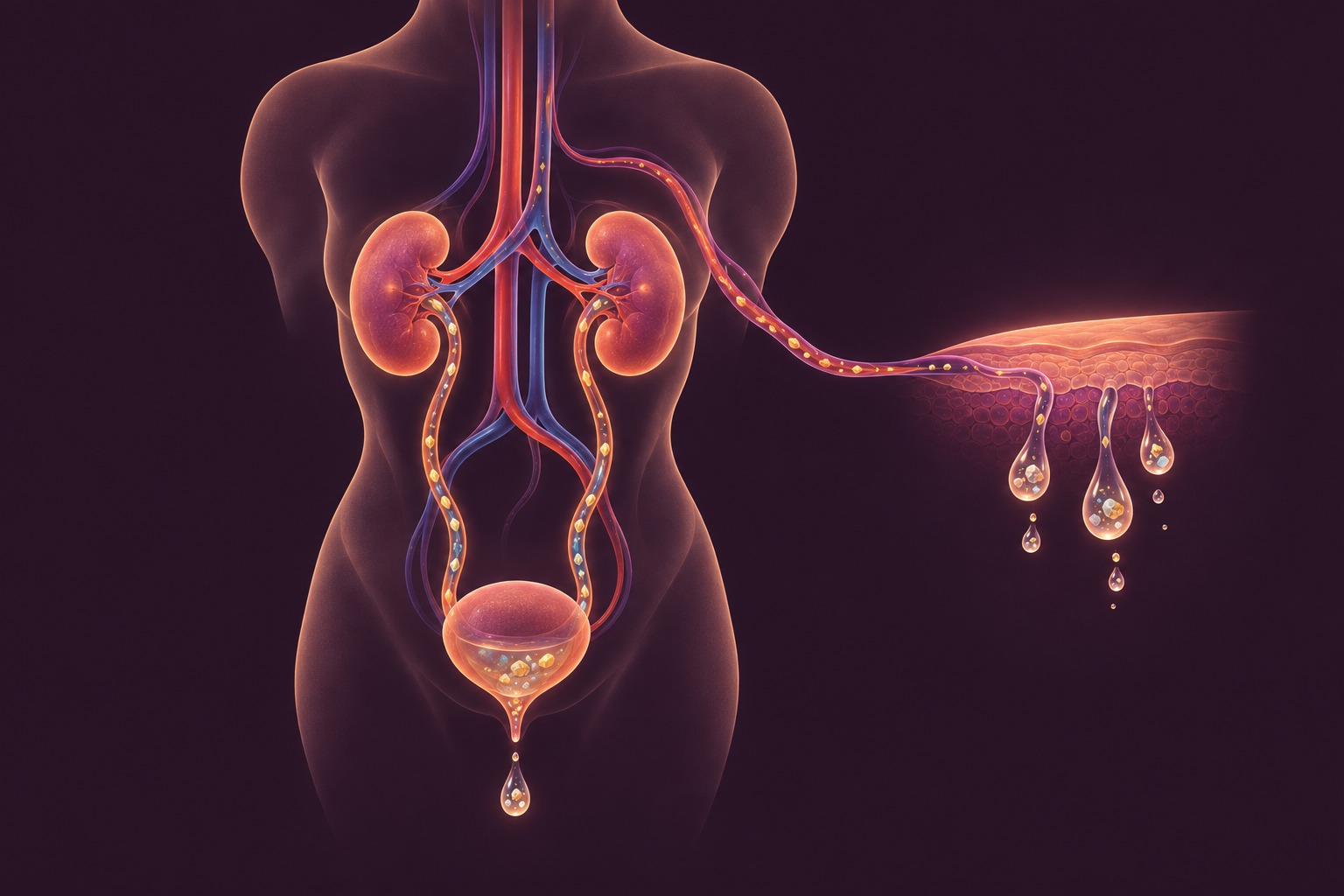
The illustration shows sweat as an additional outlet alongside the route through the kidneys.
The sweat papers benchmark against blood and urine, making urinary excretion the reference route. Skin excretion sometimes rivalled it for certain metals in higher-exposure people, but it is an additional exit, not a replacement; for ordinary exposure, there is no evidence saunas remove a meaningful extra amount.
A 2011 clinical review on sauna as a tool for cardiovascular, autoimmune and toxicant-induced problems supports saunas as one part of depuration (cleansing) protocols for environmentally induced illness, within a broader clinical approach.
What Johannes Kettelhodt's infrared-sauna talk adds
At Biohacker Summit 2022 in Helsinki, Johannes Kettelhodt, who is in the infrared sauna business, argued in "Infrared saunas - Just another wellness trend or here to stay?" that they are more than a fad. Infrared light warms the body more directly than heated air, allowing longer, gentler sessions at around 40–60°C.
Infrared is part of the invisible light spectrum that heats your core temperature. It helps you break that oxidative stress in your body and is a really nice and gentle experience.
— Johannes Kettelhodt, Biohacker Summit 2022
He said infrared therapy helps the body sweat out heavy chemicals and toxins and is used for recovery in firefighter centres.
There is evidence building up around the effects of artificially creating heat stress in the body. Raising the temperature beyond what is comfortable has severe detoxification effects.
— Johannes Kettelhodt, Biohacker Summit 2022
There is some support: the wIRA sauna study found toxic elements in infrared-sauna sweat, and the 2011 review backs sauna in depuration programmes, though all its depuration studies used radiant heating units. Neither shows health improvement, so "severe detoxification effects" overstates the evidence, and the exercise-versus-sauna comparison suggests a run may do as well or better for some metals.
He likened raised core temperature to a natural fever:
Raising your core temperature artificially is a good thing. It shows the immune system is working and your body is actually fighting bacteria or disease.
— Johannes Kettelhodt, Biohacker Summit 2022
He connected heat to mood, cited large reductions in cardiovascular and all-cause mortality risk with frequent sauna use, and closed practically:
Sweating in general is good. I try to sweat once a day and I encourage everyone to do the same.
— Johannes Kettelhodt, Biohacker Summit 2022
The research supports heat stress as a tool infrared saunas make accessible; evidence for detox remains limited.
Sauna benefits that are separate from detox
A 2024 review of passive heat therapies, focused on Finnish sauna found the most consistent evidence for Finnish saunas (typically 80–100°C, dry air), linking them to lower risk of:
- hypertension
- cardiovascular disease
- thromboembolism
- dementia
- respiratory conditions
It also links saunas to possible improvements in musculoskeletal disorders, headache and flu, mental well-being, sleep and longevity, and says sauna may augment healthy habits such as physical activity.
The 2011 clinical review cites support for sauna for cardiovascular health, including in hypertension, congestive heart failure and post-heart-attack care. It notes far-infrared saunas featured in many cardiovascular studies, that some people with COPD, chronic fatigue, chronic pain or addictions find benefit, and judges regular radiant-heat or far-infrared sauna therapy safe and beneficial.
Finnish saunas have the deepest long-term evidence; for infrared sauna benefits, the research offers cardiovascular studies and the comfort Kettelhodt described. The best-supported reason is the heat, not the sweat.
How to use a sauna sensibly
Use a sauna for its other benefits, not as detox; the systematic review calls for proper trials.
Pair heat with movement: exercise sweat carried more nickel, lead, copper and arsenic in the comparison study, and the 2024 review describes sauna as a complement to physical activity.
Heavy sweating removes nutrients alongside toxic elements (wIRA study), so frequent sweaters should favour a varied, mineral-rich diet.
Pregnancy and male fertility warrant caution. The 2011 review flags early pregnancy, as hyperthermia might be teratogenic. In a study of sauna and spermatogenesis, ten men used a Finnish sauna at 80–90°C for 15 minutes, twice a week, for three months; their sperm count and motility were strongly impaired, which matters for anyone trying to conceive.
Infrared offers lower temperatures, gentler sessions, short preheat times and the option to combine heat with other modalities. For the deepest research base, choose Finnish.
The HOLOLIFE Summit 2026, where readers can meet this magazine's community, takes place in Amsterdam on 14th–15th November 2026.
FAQ
What toxins do you sweat out in a sauna?
Studies have measured arsenic, cadmium, lead, mercury, nickel, aluminium and other toxic elements in sauna sweat, alongside nutrients such as zinc, magnesium and selenium. Amounts vary widely and are generally higher with greater exposure.
Can a sauna remove heavy metals from the body?
Sweating removes some, and one case report described mercury normalising after repeated saunas. But the systematic review says properly sized trials are needed, and one study found exercise sweat carried more of several metals.
Does an infrared sauna detox you?
The wIRA sauna study measured toxic elements in infrared-sauna sweat. Johannes Kettelhodt argued at Biohacker Summit 2022 that infrared heat has strong detox effects, but that study showed excretion, not proven benefit.
How long should you stay in a sauna?
The sources set no recommended duration; the studies used 15-minute Finnish sessions at 80–90°C and 20 minutes of continuous sweating. Kettelhodt described longer, gentler infrared sessions at around 40–60°C; pregnancy or trying to conceive warrant caution.
Sources
- Arsenic, cadmium, lead, and mercury in sweat: a systematic review (2012)
- Excretion of Ni, Pb, Cu, As, and Hg in sweat under two sweating conditions (2022)
- Effect of water filtration infrared-A (wIRA) sauna on inorganic ions excreted through sweat (2023)
- Sauna as a valuable clinical tool for cardiovascular, autoimmune, toxicant-induced and other chronic health problems (2011)
- The multifaceted benefits of passive heat therapies for extending the healthspan (2024)
- Seminal and molecular evidence that sauna exposure affects human spermatogenesis (2013)
- Talk: "Infrared saunas - Just another wellness trend or here to stay?", Johannes Kettelhodt, Biohacker Summit 2022
This article is for general information and is not medical advice.
Comments
Loading comments…