Biohacker Summit 2022 Helsinki
Benefits Of Breath-Holding: Reshaping The Breath And Enhancing Physiological Health
By Teemu Arina · · Updated
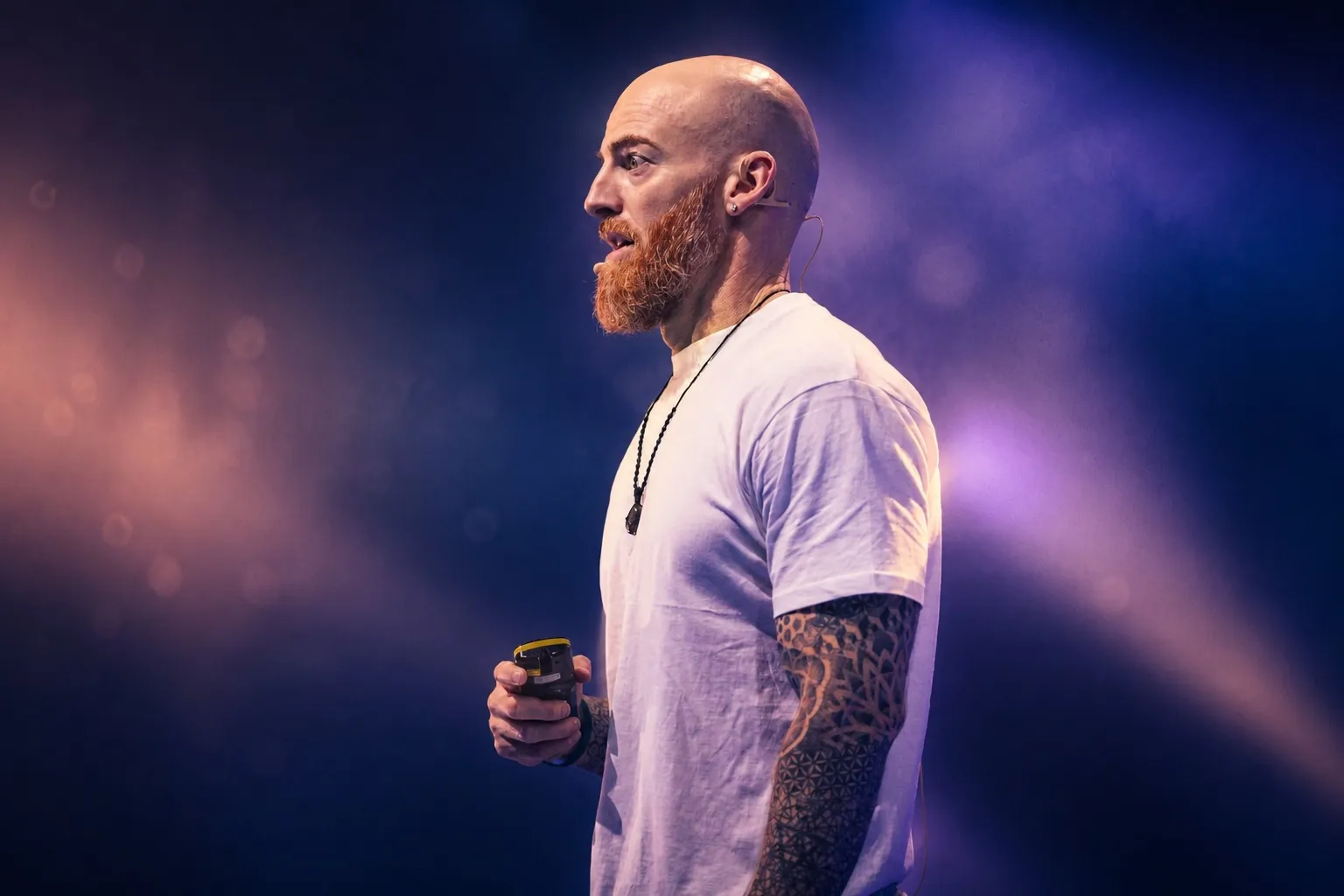
At Biohacker Summit 2022 Helsinki, Leigh Ewin Made The Case For Not Breathing, At Least For A While
Breathing is usually discussed as an act of abundance: more air, deeper inhalations, greater oxygenation, better life. But at Biohacker Summit 2022 Helsinki, held in Helsinki, Finland, on 3 to 4 June 2022, breathwork facilitator and educator Leigh Ewin turned that assumption on its head. In his presentation, Benefits of Breath-Holding, delivered on Friday, 3 June, he argued that the hidden power of respiration may lie not only in the inhale and exhale, but in the pause between them.
Ewin’s talk unfolded with the brisk assurance of a practitioner accustomed to guiding people through discomfort toward adaptation. Drawing on breathwork methods associated with performance, recovery and resilience, he presented breath-holding as a trainable physiological tool: one that could slow respiratory rate, improve oxygen delivery, dampen inflammatory responses and activate what he described as the spleen’s role as an internal “blood bank”.

The Case For Reshaping The Breath
At the centre of Ewin’s argument was a deceptively simple intervention: turning the breath from a two-part rhythm into a four-part one. Instead of merely inhaling and exhaling, he urged the audience to adopt a pattern of inhale, pause, exhale, pause.
“We want to have really healthy biomechanics of breathing,” Ewin said. “To get down to the optimal zone of around twelve to fifteen breaths per minute, we need to slow the breathing down and reshape the breath.”
The claim was both practical and philosophical. By reducing respiratory rate toward what he described as an optimal range, Ewin suggested that the body conserves energy rather than wasting it through chronic overbreathing. The implication was that modern people, often anxious, hurried and physiologically overstimulated, may be breathing too often and too inefficiently.
His framework echoed older traditions that tie breath to vitality and longevity, but he presented it in the language of biohacking and mechanism. The breath, in this telling, was not merely symbolic of life. It was a system to be trained, measured and refined.
Breath-Holding As Stress, And As Medicine
If reshaping the breath offered one route to better function, breath-holding itself offered another: controlled stress.
Ewin pointed to the logic behind practices such as Wim Hof Method-style breathing, in which rounds of deep breathing are followed by retention. The crucial moment, he said, comes not in the flood of inhalations but in the hold that follows them.
“The breath hold is the moment when you get oxygen delivery,” he said. “CO2 levels rise and oxygen is released from the hemoglobin in the blood. This is how more oxygen gets delivered into your cells.”
This is the paradox at the heart of breath retention. To the untrained observer, holding the breath appears to deprive the body. Ewin’s argument was that it can, under controlled conditions, do the opposite. As carbon dioxide rises, oxygen is released more readily from hemoglobin and delivered into tissues. In other words, the pause becomes a delivery mechanism.
He framed this process within the broader concept of hormesis, the biological principle that small, acute doses of stress can provoke beneficial adaptation.
“Acute bursts of stress, like the rise of adrenaline and cortisol, can suppress inflammatory proteins and cells,” Ewin said. “This is a hormetic response, a stress response your body adapts to that is actually good for you.”
Drawing on findings he associated with endotoxin research around breathwork, he argued that short, deliberate bouts of breath-induced stress may elevate adrenaline, cortisol and dopamine while suppressing inflammatory cytokines. According to Ewin, the effect could persist for up to a week, a striking claim that placed breath-holding not merely in the realm of relaxation, but of immune modulation.
The Spleen’s Quiet, Remarkable Role
The most vivid portion of the talk arrived when Ewin turned to an organ that receives far less popular attention than the lungs or heart: the spleen.
“The spleen is like a little blood bank containing some of the healthiest blood in your body,” he said. “Breath holding and apnea trigger an evolutionary adaptation that releases this healthy blood straight into your bloodstream.”
Here Ewin described the spleen as a reservoir, holding a supply of red blood cells that can be mobilised under stress. During apnea, he said, the spleen contracts and releases those cells into circulation, increasing oxygen-carrying capacity while also participating in the metabolism of iron. It was a portrait of the body as not only reactive but strategically prepared, carrying internal reserves for moments of challenge.
He linked this adaptation to populations known for diving and prolonged breath-holding, suggesting that repeated exposure can strengthen the response over time. In that sense, breath retention was not simply a trick of endurance. It was a practice capable of reshaping physiology.
Trainability, Not Talent
One of the more democratic notes in Ewin’s presentation was his insistence that these effects were not the exclusive property of elite freedivers or the genetically gifted. Training mattered, certainly, but adaptation was available more widely than many might imagine.
“The effects of breath holding are increased if you keep training,” he said. “There is a bit of variation between a trained freediver and someone who is not, but you can get there too. It shows the incredible trainability of this.”
That emphasis on trainability aligned neatly with the ethos of Biohacker Summit 2022 Helsinki, where the body is often treated not as a fixed inheritance but as a system open to intervention. Ewin, whose background includes training with Wim Hof Method, Oxygen Advantage and Breatheology, brought to the stage the confidence of someone fluent in both experiential practice and performance-oriented health culture.
A Pause That Asked Bigger Questions
What made Ewin’s presentation compelling was not simply its catalogue of physiological claims, but the larger question it posed. In a culture obsessed with optimisation, speed and maximisation, he suggested that health may sometimes depend on restraint. Less breathing, more pause. Less automaticity, more control.
There was, too, a subtle inversion in his message. Breath is commonly sold as a way to calm down, soften, let go. Ewin’s version was sharper than that. Breath-holding was not merely soothing. It was provocative. It stressed the body in order to train it. It withheld in order to deliver. It interrupted in order to restore.
In that sense, Benefits of Breath-Holding was about more than apnea. It was about the body’s capacity to adapt when discomfort is approached deliberately rather than avoided reflexively. At Biohacker Summit 2022 Helsinki, Leigh Ewin made the pause feel newly consequential: a small silence in the respiratory cycle, and perhaps a meaningful one in the search for better health.
Frequently asked questions
What does Leigh Ewin mean by reshaping the breath?
Turning a two-part rhythm into a four-part one: inhale, pause, exhale, pause. We want to have really healthy biomechanics of breathing, he said, treating the pauses as part of the pattern rather than gaps between the useful bits.
Why hold the breath at all?
As controlled stress. Ewin pointed to the logic behind practices such as Wim Hof Method-style breathing, where rounds of deep breathing are followed by retention, and argued the decisive moment comes in the hold rather than in the flood of inhalations before it.
What does the spleen have to do with breathing?
More than most people assume. The spleen is like a little blood bank, Ewin said, turning the talk toward an organ that receives far less popular attention than the lungs or the heart but plays a real part in what breath-holding does.
About the event
This recap is part of the Biohacker Summit 2022 Helsinki series, recorded in Helsinki on 3 and 4 June 2022. Read the summary of the whole event or join the next edition, HOLOLIFE Summit 2026 Amsterdam, on 14 and 15 November 2026.
In this story

Comments
Loading comments…