Biohacker Summit 2022 Helsinki
Time To Evolve: How MAD Metaverse Turned NFTs Into A Biohacking Fantasy
By Teemu Arina · · Updated
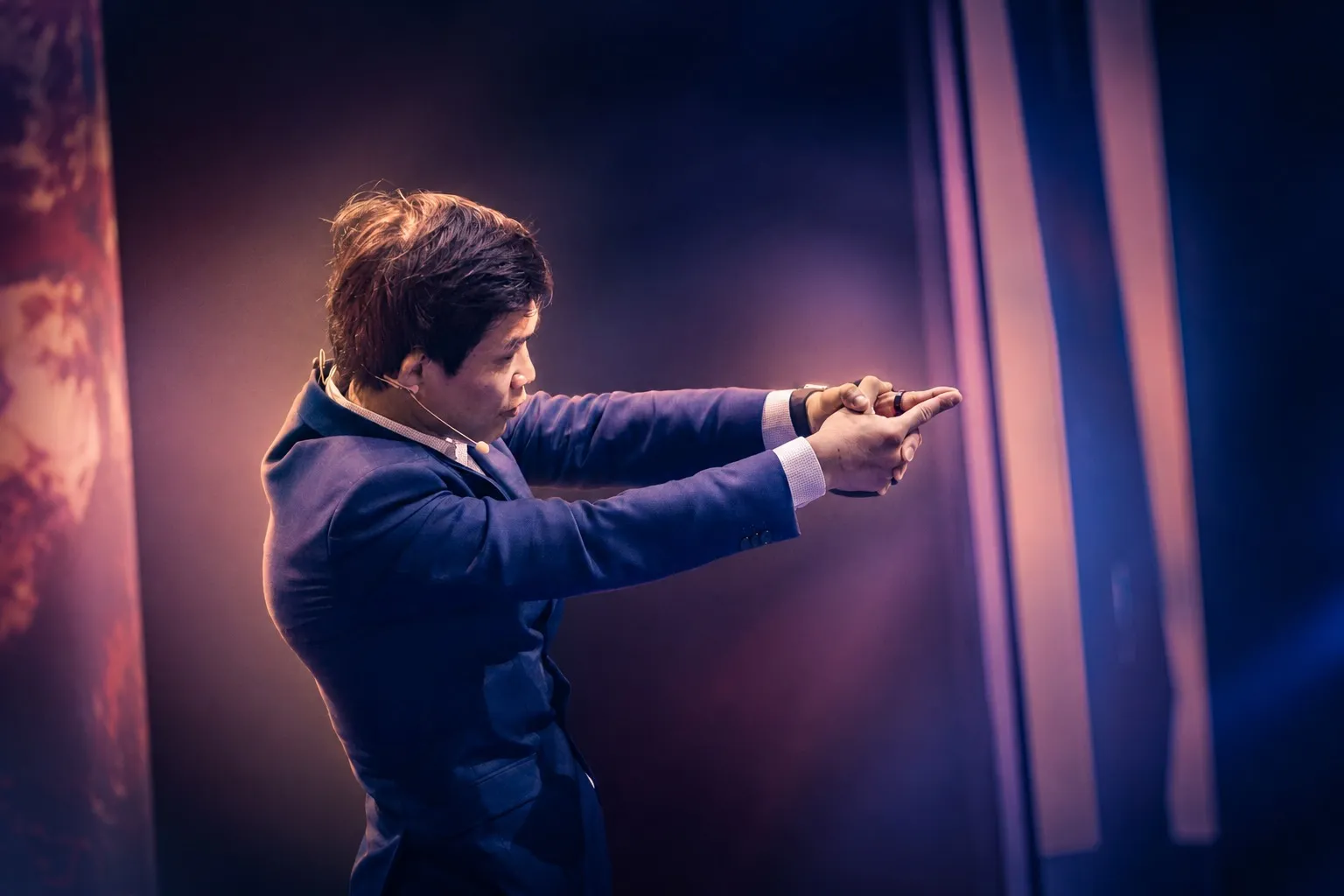
At Biohacker Summit 2022 Helsinki, Sid Of MAD Metaverse Pitched A Future In Which Digital Assets Did Not Sit Still, But Split, Mutate And Learn To Live
On Friday, 3 June 2022, at Biohacker Summit 2022 Helsinki in Helsinki, Finland, Sid of MAD Metaverse, joined by chief science officer Temu Harina, offered a vision of NFTs that was less gallery wall than petri dish.
The presentation, titled “Time to Evolve: Metacells, Metascientists & Evolving NFTs”, placed blockchain culture inside the language of biology, simulation and experimental play. In place of the now-familiar static token, Sid described a system of living, mutating assets shaped by users inside a gamified ecosystem. It was a pitch that reached beyond digital collectibles and into something more ambitious: an attempt to recast NFTs as instruments of participation, community ownership and even speculative scientific research.
“What you are experiencing right now is not real,” Sid told the audience. “Look at this stage; look at this guy on stage. This cannot be real. We are already in a metaverse.”
It was a line designed to provoke, but it also served as the keynote argument. For MAD Metaverse, the metaverse was not a distant destination. It was already here, stitched together from attention, identity, gaming, blockchain and belief.
From Static Art To Evolving Organisms
The project began with a challenge to the dominant NFT model. Too much of the space, Sid suggested, had been trapped in stillness: collectible images, speculative trading, digital status symbols detached from meaningful use.
MAD Metaverse proposed something else.
At the heart of the ecosystem sat 10,200 unique NFTs, including influencer-inspired scientist avatars that acted as access points into the platform’s broader world. These were not presented merely as decorative objects, but as tickets into a system of experimentation. Users would enter what the team called a digital lab and begin working with MAD Metacells, single-cell NFT organisms designed to split, evolve and transform.
“A key component of MAD Metaverse is that these are evolving, mutating, and transforming,” Sid said. “It is an evolutionary concept that takes its inspiration from biology.”
That biological framing mattered. The project borrowed not just imagery from science, but a way of thinking. Evolution, in this account, became utility. Mutation became gameplay. NFTs ceased to be endpoints and instead became beginnings.
The Scientist As Player, Creator And God
MAD Metaverse wrapped its world in a theatrical mythology. The speaker biography described the platform as a place “where you come to start creating, living, breathing NFTs” and, with deliberate provocation, “where you play God.”
The ecosystem cast participants as scientists, or “Metascientists”, whose role was to influence the development of digital life forms. In the project’s own fiction, users watched over cells as they underwent meiosis, generated nanocells and potentially evolved into more complex beings. The conceptual move was clear: to turn ownership into stewardship, and collection into intervention.
Sid underscored this when discussing avatars, invoking their etymology as a way of lifting the idea above profile-picture culture.
“Avatar is a Sanskrit word meaning the descendant from God,” he said.
The remark was part linguistic flourish, part philosophical signal. MAD Metaverse wanted avatars to mean more than representation. They were intended as active extensions of human will inside a programmable environment.
A World Built On Mutation And Consequence
If the project’s language sometimes leaned grandiose, its mechanics were grounded in a recognisable gaming logic. Players acquired scientist NFTs, entered the lab and experimented on Metacells whose future forms depended on those interactions.
“It can become anything depending on the scientists experimenting on it,” Sid said. “It can become sentient, or it can become a biohacker and do wonders for humanity and all beings in the universe.”
That framing gave the game a moral and imaginative elasticity. The organism might become beneficial, dangerous or simply strange. What mattered was that the asset was not fixed. It had trajectory. It had consequence. It could be altered by choices, systems and collaboration.
The comparison offered during the session was to strategy games such as Civilization, with their branching paths of progress and layered development systems. MAD Metaverse appeared to be borrowing that sense of technological and biological unfolding, then attaching it to NFT infrastructure. The promise was not only ownership, but emergence.
The DAO Dream And The Politics Of Ownership
Beneath the spectacle lay a familiar Web3 claim, though one delivered with unusual clarity: decentralisation, Sid argued, should matter more than crypto as a buzzword.
He described MAD Metaverse as a community-driven ecosystem intended to be governed through a DAO, or Decentralized Autonomous Organization, with the long-term aim of placing the game in the hands of its players. The platform also incorporated play-to-earn mechanics, allowing users to earn cryptocurrencies and in-game NFTs through participation.
In an industry often accused of dressing speculation in the language of liberation, this was a significant part of the pitch. Sid presented decentralisation not as a technical novelty but as a redistribution of power.
The argument was that players should not simply consume a world. They should own it, shape it and benefit from its growth.
Whether such promises could withstand the volatility and contradictions of the broader crypto economy was another question. But on stage in Helsinki, MAD Metaverse positioned itself firmly within that democratic aspiration.
Simulation As A Tool For Science
Perhaps the most intriguing moment of the talk arrived when the conversation moved beyond gaming and into research.
“Any gamified system can be used as a simulation,” Sid said. “We are looking into how we can adapt the game for scientific research and biohacking research.”
That sentence did more than broaden the scope of the project. It linked MAD Metaverse directly to the ethos of Biohacker Summit 2022 Helsinki, an event built around self-experimentation, longevity, human optimisation and the merging of biology with technology.
Here, the game was no longer framed only as entertainment or economy. It became a possible model, a sandbox for hypothesis and behavioural design. Chief science officer Temu Harina reinforced that sense of crossover, presenting the project as a community-driven evolutionary system inspired by biology, biohacking and the future of humanity.
This was, in essence, the boldest proposition of the presentation: that a blockchain game could eventually serve as a kind of conceptual bridge between digital simulation and scientific exploration.
An Expanding Ecosystem, Not A Single Product
Sid also described MAD Metaverse as more than one game. It was, he said, an ecosystem of games, with a roadmap extending beyond the initial scientist NFTs and Metacells toward a dedicated battle title.
The team said it had partnered with Karuru Games, while the broader project materials referenced Kevuru Games, a studio associated with work connected to major entertainment and gaming properties. In the presentation, Sid invoked experience linked to titles and franchises such as Fortnite, Star Wars, Disney and Electronic Arts. The message was one of industrial credibility: this was not merely a concept deck, but a project seeking to marry crypto-native experimentation with established game development expertise.
That mattered because many Web3 gaming projects of the period struggled to persuade audiences that utility would ever be more than a slogan. MAD Metaverse was attempting to answer that scepticism with scale, narrative and production ambition.
Between Hype And Imagination
The language of the session was unmistakably of its moment: metaverse, DAO, play-to-earn, utility, evolution. In 2022, these terms carried both magnetism and fatigue. Yet what made this presentation stand out was the coherence of its metaphor. MAD Metaverse did not simply add gaming features to NFTs. It tried to build an entire philosophy around the idea that digital objects should behave more like life.
That was the central seduction of the project. Not ownership alone, but transformation. Not scarcity alone, but growth. Not a token sitting inert in a wallet, but an entity that might split, mutate, battle and perhaps one day simulate something useful.
At Biohacker Summit 2022 Helsinki, Sid of MAD Metaverse, alongside Temu Harina, offered a worldview in which blockchain was not the final story, but only the substrate. The more interesting question was what kind of life could be coaxed from it.
For a culture increasingly dissatisfied with static screens and passive systems, the appeal was obvious. The future, in this telling, did not need more images. It needed organisms.
Frequently asked questions
What was MAD Metaverse proposing?
NFTs that behave less like gallery pieces than like organisms. The project began with a challenge to the dominant model, which Sid suggested had been trapped in stillness: collectible images, speculative trading and digital status symbols detached from meaningful use.
What role do participants play?
The ecosystem cast them as scientists, or Metascientists, whose job was to influence how digital organisms developed. The platform described itself as a place where you come to start creating living, breathing NFTs and, with deliberate provocation, where you play God.
How did the mechanics work?
On a recognisable gaming logic. Players acquired scientist NFTs, entered the lab and experimented on Metacells whose future forms depended on those interventions, which is what the project meant by mutation and consequence.
About the event
This recap is part of the Biohacker Summit 2022 Helsinki series, recorded in Helsinki on 3 and 4 June 2022. Read the summary of the whole event or join the next edition, HOLOLIFE Summit 2026 Amsterdam, on 14 and 15 November 2026.
In this story
Comments
Loading comments…