News
Microbiome vs Microbiota: Understanding Your Internal Ecosystem
By Teemu Arina ·

Microbiome and microbiota describe connected parts of the microbial world in and on the body: microbiota are the microorganisms, while the microbiome includes those organisms, their genetic material and functions. The distinction is useful, but the practical question is what shapes these communities and what everyday choices may support them.
At Biohacker Summit, speakers have focused on diet, movement, routine and individual variation. Gut microbes are involved in health-related processes, but a microbial pattern alone cannot explain a person’s health or predict which intervention will work.
Defining the ecosystem: microbiota vs microbiome
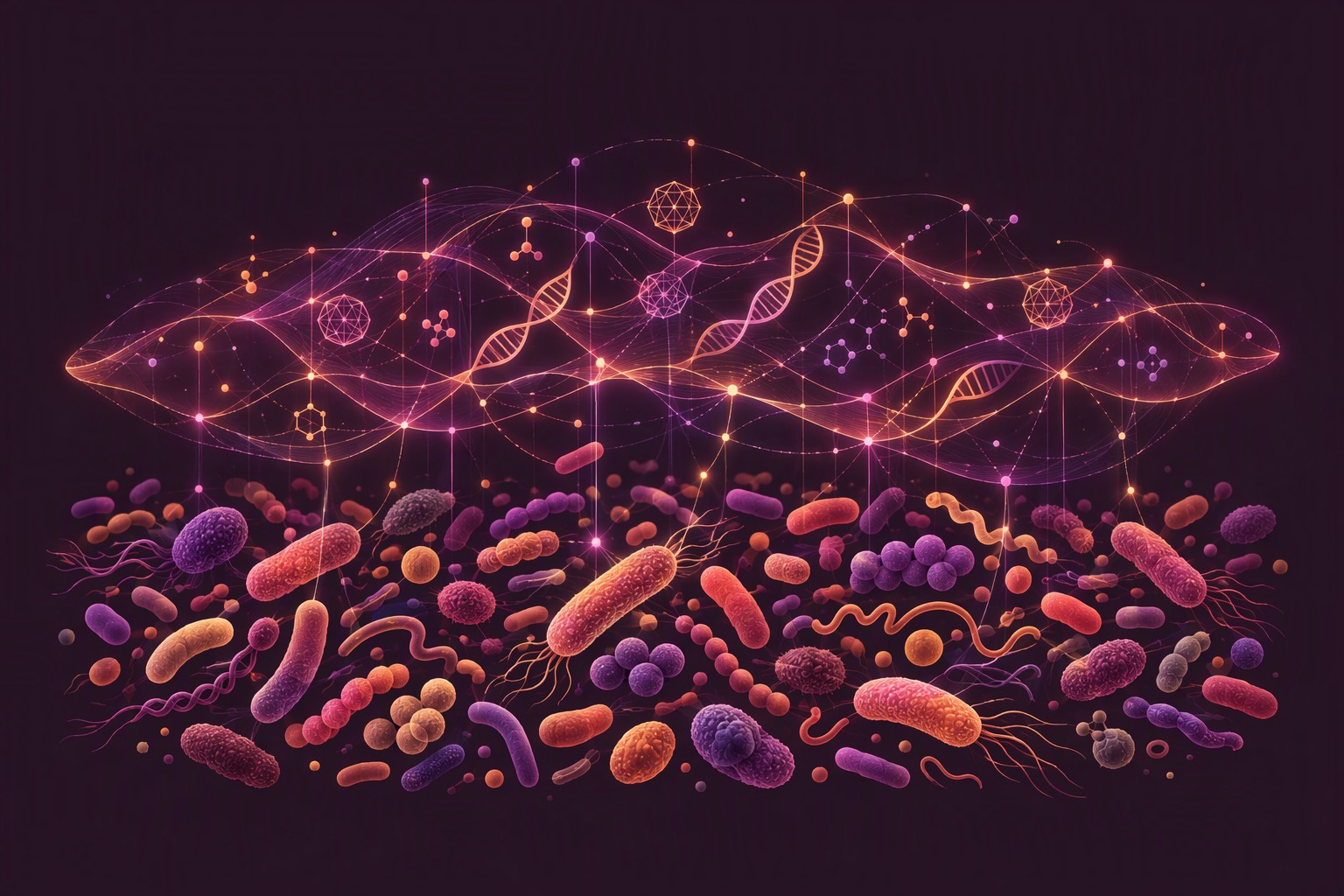
An illustration distinguishing between the microbiota, the organisms themselves, and the microbiome, the broader system of their functions and genetic material.
Microbiota refers to microorganisms in a particular place, such as the gut or skin. Microbiome describes the broader system: microbes, their genetic material and functions. Identifying organisms is not the same as knowing what they do.
In the gut, microbial genes contribute to fibre breakdown and the production of short-chain fatty acids, vitamins and other compounds. A review discusses their possible relevance to blood-glucose regulation but notes that human evidence does not establish a clear causal relationship (review of the gut microbiome and hyperglycaemia).
Viewing the microbiome as a working ecosystem, rather than a list of "good" and "bad" bacteria, puts test results in perspective. Diet, medication, gut movement and stool frequency or consistency are associated with differences in gut communities. Those differences do not prove that particular microbes caused a condition (review of the human gut microbiome).
The human microbiome: a full-body network
The human microbiome includes communities across the body, each with its own environment. At Biohacker Summit 2017 Helsinki, Ben Greenfield described variation between body sites, including between a person’s hands. No single community represents every microbial habitat.
Microbes also reflect relationships between people and their environment. A 2023 study found some bacteria associated with fruits and vegetables in human gut metagenomes, suggesting plant-associated microbes may contribute to gut diversity, though these were found at low abundance (study of fruit and vegetable bacteria in the gut).
Greenfield encouraged people to spend time outdoors:
Get outside and breathe the air to increase the diversity of your microbiome. By breathing deeply outdoors, you increase your cooperation with the environmental microbiome.
— Ben Greenfield, Biohacker Summit 2017 Helsinki
A review of microbiota and tuberculosis describes possible effects of microbial communities on immune function and metabolism. It also notes that infection treatment may alter the microbiome (review of microbiome and tuberculosis).
Gut microbiota and its role in longevity
The gut microbiota interests longevity researchers because it communicates with other body systems through metabolism and immune activity. A microbial profile, however, is not a measure of lifespan.
At Biohacker Summit 2018 Toronto, Dr Afsoun Khalili described communication between gut microbes and the brain through neural, endocrine and immune pathways. A depression research review also describes bidirectional communication between the gut microbiota and central nervous system, while emphasising the need to identify specific bacterial strains (review of gut microbiota and depression).
Khalili also discussed findings linking regular, low-dose physical activity with supportive gut bacteria.
Physical activity that was performed at a low dose on a regular basis seem to really help support the growth of good bacteria in the gut. Exercise can be used as an effective therapy for conditions related to an unbalanced microbiome.
— Dr Afsoun Khalili, Biohacker Summit 2018 Toronto
A type 2 diabetes review reports links between gut microbes and glycaemic control but says human evidence is insufficient to establish causality (review of the gut microbiome and hyperglycaemia). An obesity review likewise finds that causal relationships and mechanisms remain unresolved (review of the gut microbiome and obesity).
Personalisation: why one-size-fits-all probiotics fail
The same food or probiotic may not produce the same response in everyone. At Biohacker Summit 2018 Toronto, Khalili argued against universally prescribing probiotics.
Probiotics should not be universally given as a one-size-fits-all supplement. The future of health lies in tailoring probiotics to an individual based on their own unique gut microbiota.
— Dr Afsoun Khalili, Biohacker Summit 2018 Toronto
In his 2017 Helsinki talk, Ben Greenfield similarly noted that people can have markedly different microbial communities, so a diet that suits one person may not suit another. Personalisation can start by noticing how food, activity and routines relate to digestion. A microbiome result is not a diagnosis or a guarantee that a supplement will help. Microbial differences do not automatically show cause and effect (review of the human gut microbiome).
Practical steps for a healthy gut microbiome
A healthy gut microbiome is not defined by one universal list of "good" bacteria. The talks point to manageable habits.
Include a variety of plant foods. Greenfield recommended fibre-rich foods and colourful berries. A 2023 study associated plant diversity and vegetable-consumption frequency with a higher proportion of fruit- and vegetable-associated gut bacteria (study of fruit and vegetable bacteria in the gut).
Try fermented foods if they suit you. Greenfield suggested kimchi, sauerkraut, yoghurt and kefir, and pairing prebiotic fibres with fermented foods.
Introduce a wide variety of fermented foods into your gut. Mixing ferments like kimchi, sauerkraut, yogurt, and kefir helps you build a robust and diverse microbiome.
— Ben Greenfield, Biohacker Summit 2017 Helsinki
Greenfield advised considering both a meal’s nutrient density and digestibility, citing the soaking and rinsing of quinoa as an example.
Ask yourself two questions when looking at your plate: is it nutrient dense and is it digestible? Filtering your choices this way will help you choose foods that truly support your gut.
— Ben Greenfield, Biohacker Summit 2017 Helsinki
Move regularly and keep routines steady. Khalili highlighted regular activity and the gut’s circadian rhythms.
Change one thing at a time. Introducing several changes at once makes it harder to identify which relates to wellbeing. A simple record of meals and routines may reveal patterns, but cannot diagnose a condition.
Details of wider health and biohacking conversations are available at HOLOLIFE Summit 2026 Amsterdam.
The future of microbiome decoding
Microbiome testing can describe aspects of a microbial community, but a report cannot fully explain how it functions. Diet, medication and bowel habits are among the factors associated with differences in gut microbiota. Differences between groups do not establish causality (review of the human gut microbiome).
The challenge is to understand which microbial functions matter for whom. A type 2 diabetes review discusses functions such as fibre breakdown alongside the limits of current human evidence (review of the gut microbiome and hyperglycaemia).
At Biohacker Summit 2024 Helsinki, longevity panel speaker Ingrid Lesdorf discussed interactions between genetics, lifestyle and the exposome. Microbial information, if used, belongs alongside other aspects of a person’s health and environment. Persistent symptoms call for clinical assessment rather than reliance on a microbiome report alone.
FAQ
What is the difference between microbiome and microbiota?
The microbiota are the microorganisms living in a place like the gut. The microbiome includes those organisms, their genetic material and functions.
What is the best way to fix your gut microbiome?
There is no single fix. Suggestions include consuming varied plant and fermented foods, regular movement, and steady routines.
What are signs of a bad gut microbiome?
No specific symptoms can diagnose a "bad" microbiome. Digestive and health issues have many causes that a single report cannot identify.
Is it worth getting a microbiome test?
A test can explore microbial community aspects but is not a diagnosis. Use results to inform practical decisions alongside diet and health context.
Sources
- The edible plant microbiome: evidence for the occurrence of fruit and vegetable bacteria in the human gut
- The gut microbiome as a target for prevention and treatment of hyperglycaemia in type 2 diabetes
- Human gut microbiome: hopes, threats and promises
- Updated review of research on the gut microbiota and their relation to depression
- The Human Microbiome and Obesity: Moving beyond Associations
- The Microbiome and Tuberculosis: Early Evidence for Cross Talk
- Talk: “Decoding Your Microbiome – The Ultimate Gut Hack”, Ben Greenfield, Biohacker Summit 2017 Helsinki.
- Talk: “Probiotics – Are They Really Necessary”, Dr Afsoun Khalili, Biohacker Summit 2018 Toronto.
- Talk: “Biohack Your Longevity (Panel)”, Ingrid Lesdorf, Eduard de Wilde and Samina Rind, Biohacker Summit 2024 Helsinki.
This article is for general information and is not medical advice.
In this story


Comments
Loading comments…