Biohacker Summit 2023 Amsterdam
Beyond Normal: Navigating Altered States Of Consciousness For Personal And Collective Growth
By Teemu Arina · · Updated
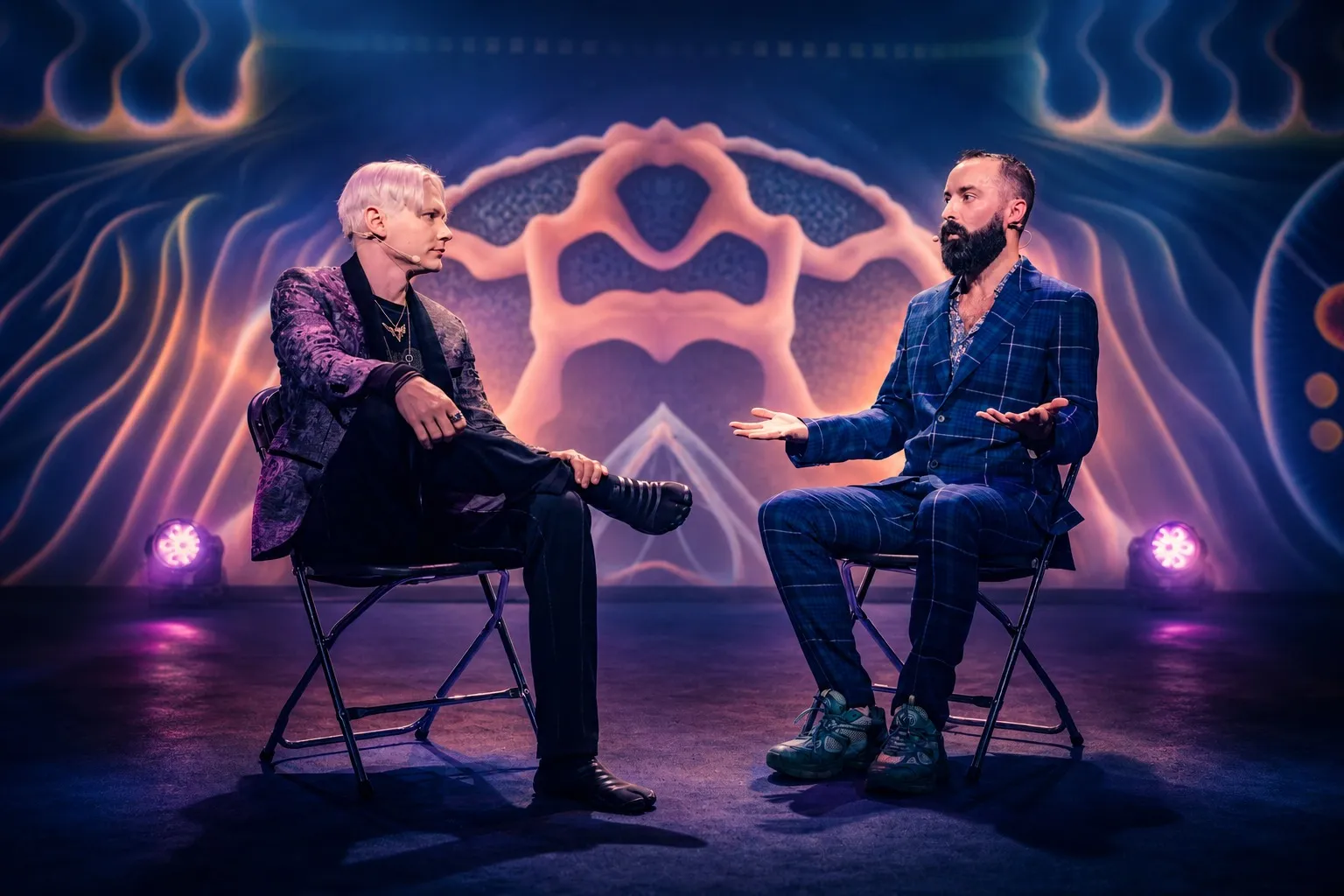
At Biohacker Summit 2023 Amsterdam, Anna Catharin Heil Argued That True Change Begins Where Comfort Ends
On Saturday, 14 October 2023, at Biohacker Summit 2023 Amsterdam in the Netherlands, Anna Catharin Heil stepped onto the stage with a message that cut through the conference language of optimization and performance. Her presentation, Consciousness Unleashed - The Transformative Power of Altered States of Consciousness, was not a sales pitch for extremity, nor a romantic hymn to psychedelia. It was, instead, a precise and personal argument for disruption: if the life one is living no longer yields the desired results, then “normal” may be the very thing standing in the way of transformation.
Heil, a birth doula, psychedelic ceremony facilitator, holistic health coach and breathwork professional, spoke from a place where the autobiographical met the philosophical. Her account moved from Berlin nightlife to Amazonian ritual, from the boardroom self she called “Corporate Anna” to the ceremonial spaces in which she has since guided hundreds through altered states. Yet the force of the talk lay not in spectacle, but in its central insistence that altered states are not fringe anomalies. They are part of the architecture of being human.
The Tyranny Of The Default Self
Heil’s framing of “normal” was one of the most arresting features of the presentation. Normal, she suggested, is not simply social convention. It is the accumulated machinery of identity: the habits, beliefs, preferences, relationships and reflexes that come to define a person’s default mode of being.
“If your default ways of being are creating the results you want, then normal is great,” Heil said. “But if you are not seeing the results you want, then it is time to get out of that normal.”
That line landed because it challenged one of modern life’s deepest contradictions. Many people desire change while remaining fiercely attached to the conditions that prevent it. “We often want change, but we do not want to change,” she said. In that compact sentence sat an indictment of self-help culture, wellness consumerism and the broader fantasy that new outcomes can emerge from unchanged patterns.
Her point was not abstract. It was rooted in the often painful recognition that a repeated life, however familiar, can become a closed circuit. Staying inside the known may feel safe, but it can also become a form of quiet surrender.
From Berlin Nights To The Amazon Rainforest
Heil gave the audience a portrait of two selves. There was the high-achieving young consultant with a double degree, a strong salary and a career in Berlin’s startup world. There was also the woman pulled toward nightlife, substances and the unstable borderlands of consciousness, sensing that these states held something more than stimulation, but finding that repetition without direction became draining rather than liberating.
That search eventually led her to Brazil, where she spent a month in sacred Dieta with the Awanawha tribe in the Amazon rainforest. The experience, she recounted, involved severe physical austerity, prolonged ayahuasca ceremonies and long periods of isolation. She did not offer it as a prescription. If anything, she took care to deny the seduction of imitation. The point was not that everyone should disappear into the jungle. The point was that there are forms of knowing available only when ordinary identity loosens its grip.
In that sense, her personal story functioned less as confession than as evidence. Altered states, she suggested, can reveal what daily consciousness keeps hidden, but only if approached with discipline, humility and care.
Ancient Ritual, Modern Hunger
Heil spoke of the Awanawha with unusual balance, refusing both idealisation and dismissal. Indigenous communities, she noted, are neither mystical caricatures nor relics of primitivist fantasy. They are human communities shaped by extraordinary resilience, carrying traditions that survived suppression, addiction, violence and near-erasure.
What she found significant was not a myth of purity, but the tribe’s continued use of meaningful, collective rituals to enter altered states of consciousness together. In those rituals, she saw a clue for a fractured modern society. Where contemporary life often isolates crisis, commodifies healing and pathologises the strange, ritual offers a container in which the unknown can be entered communally.
For Heil, this mattered not only spiritually but socially. Such shared experiences, she argued, may help communities metabolise suffering rather than merely endure it. That proposition resonated beyond the wellness world, touching a wider cultural question: what practices do modern societies possess for collective transformation, rather than private coping?
The Weird As A Necessary Passage
One of Heil’s most memorable refrains was also among the simplest. “To get out of normal, we need to get into the unknown and the uncomfortable,” she said. “It must feel weird because otherwise it would not be new. Weird is the name of the game.”
There was clarity in her use of the word “weird.” She deployed it not as provocation, but as diagnosis. The new often arrives wearing the costume of discomfort. A fresh perspective does not feel like confirmation. It feels destabilising. And because contemporary society is deeply invested in predictability, altered states are often treated as suspect, irrational or unreal.
Heil challenged that reflex. What if the very states dismissed as eccentric or excessive are, under the right conditions, capable of helping people interrupt dead patterns before catastrophe does it for them? What if one need not wait for illness, heartbreak, bereavement or burnout to force a reckoning?
The Safe Crisis
This was where her argument became most practical. Heil described modalities such as fasting, breathwork, saunas, darkness, pilgrimage, cold exposure and psychedelics as ways of creating a “safe crisis”. The phrase is telling. A crisis, in ordinary life, tends to arrive uninvited and with consequences beyond control. A safe crisis, by contrast, is deliberately bounded. It is an intentional disturbance of the familiar within a structure designed to support reflection rather than collapse.
The distinction is crucial. Heil was not celebrating overwhelm. She was advocating conditions in which identity can be questioned without the nervous system being pushed into chaos.
Her language here drew on a therapeutic understanding of tolerance and capacity. A well-held altered state, she suggested, can expand a person’s zone of safety and resilience. But if intensity is misjudged, the result may not be healing at all. It may be confusion, retraumatisation or a recoil back into rigid self-protection.
The Case For The Minimum Effective Dose
Against cultures of excess, Heil proposed a principle both modest and radical: the minimum effective dose. Whether in psychedelics, breathwork, fasting or any other state-shifting practice, more is not necessarily wiser. The aim is not annihilation, nor performance, nor a dramatic story to retell. The aim is to enter far enough into the unknown to learn, while remaining sufficiently resourced to integrate what is found there.
This challenged a certain mythology around transformation, the idea that healing must be violent, maximal or heroic in order to be real. Heil’s experience as a facilitator appeared to have taught her the opposite. Lasting change often comes not from being blasted apart, but from being able to “co-navigate”, to remain in relationship with the experience rather than simply endure it.
In a culture that rewards intensity, that was a quietly subversive claim.
Psychedelics, Promise And Responsibility
Heil addressed the growing interest in psilocybin with equal parts enthusiasm and warning. She acknowledged the surge in scientific research, media attention and cultural legitimacy, particularly in the Netherlands where psilocybin truffles remain legal. She also made plain her belief in their transformative potential, citing both research and the sessions she has facilitated.
But she was unequivocal about the risks of careless use. Legality, she implied, is not the same thing as safety. Increased demand brings increased supply, and with it the possibility of poorly held, underprepared or irresponsible experiences masquerading as healing.
Her answer was rigorous facilitation. In discussing her work and the wider ecosystem around it, she described an emerging multidisciplinary field that bridges ancient ritual with modern science, involving psychologists, integration coaches, somatic practitioners, musicians and other specialists. The point was not to sanitise the experience into something clinical, but to build containers capable of holding vulnerability without exploiting it.
Integration Is Where The Real Work Begins
If one idea dominated the latter part of Heil’s talk, it was integration. The altered state itself, she argued, is only the beginning. Insight that does not enter daily life remains theatre. Revelation without embodiment changes nothing.
“It is not about what you experience, it is actually about what you are able to take home,” she said.
This is the weakness of much contemporary fascination with consciousness expansion: it can become acquisitive, another form of collecting extraordinary moments. Heil resisted that tendency. The purpose of seeing differently is not to remain enchanted by the vision, but to allow it to alter one’s habits, relationships and sense of responsibility. The goal is not escape from ordinary life, but the creation of a “new normal” within it.
Childbirth And The Radical Normality Of Altered States
One of the talk’s most striking turns came when Heil drew on her work as a doula. Childbirth, she noted, often brings women into a natural altered state, a trance-like condition in which pain becomes more manageable and instinctive intelligence comes to the fore. The body, given the chance, knows how to shift consciousness in service of life itself.
This observation deepened her core argument. Altered states are not foreign to human beings. They are not outside nature. They are woven into our most primal thresholds.
“Altered states of consciousness are not an abnormality,” Heil said. “They are actually a normality. They are at the source of life, and we should consciously cultivate them because there is so much wisdom to them.”
It was a powerful reframing. In a culture that often medicalises, marginalises or trivialises non-ordinary states, Heil placed them back at the centre of human experience.
Safety, Humility And Shared Wisdom
Heil’s closing principles were notable for their ethical seriousness. Intention matters, she said. So does dosage. So does integration. But beneath all of it lies safety. Quoting her husband, Kasper van der Meulen, who also spoke at the event, she repeated a formula that functioned as both warning and guide: vulnerability plus safety equals healing; vulnerability plus unsafety equals trauma.
Then came humility. In an age prone to spiritual vanity and therapeutic narcissism, this may have been the most necessary lesson of all. Altered states, Heil argued, are not a ladder by which one rises above others. They do not confer superiority. The point is not to become exceptional, but to become more honest, more connected and more useful.
“All insights and wisdom we receive are not given to us for ourselves, but are given to us for the world,” she said.
That line lingered after the talk ended. It shifted the whole discussion from private transformation to collective obligation. Healing, in Heil’s account, was never merely personal. It was relational. One enters the unknown not simply to discover a truer self, but to return bearing something of value for others.
A Call To Step Beyond Normal
At Biohacker Summit 2023 Amsterdam, amid a landscape often dominated by metrics, protocols and the pursuit of personal edge, Anna Catharin Heil offered something rarer: a moral and existential frame for transformation. Her talk did not reject biohacking’s appetite for possibility. It widened it, asking what consciousness work is for, who it serves and how it might be done without violence to the self.
The answer she offered was neither simple nor soothing. Growth requires disruption. The unknown will feel strange. Safety is non-negotiable. Integration is everything. And the deepest insights are not trophies, but responsibilities.
To step beyond normal, Heil suggested, is not to become less human. It is to risk becoming more fully so.
Frequently asked questions
How does Anna Catharin Heil define normal?
Not as social convention but as the accumulated machinery of identity: the habits, beliefs, preferences, relationships and reflexes that become a person's default mode of being. If your default ways of being are creating the results you want, she said, then normal is great.
Why does she insist change must feel weird?
Because novelty announces itself as discomfort. To get out of normal we need to get into the unknown and the uncomfortable, she said, and it must feel weird because otherwise it would not be new. She used the word as diagnosis rather than provocation.
What were the two selves she described?
The high-achieving young consultant with a double degree, a strong salary and a career in Berlin's startup world, and the woman pulled toward nightlife, substances and the borderlands of consciousness, who sensed those states held more than stimulation but found repetition without direction went nowhere.
About the event
This recap is part of the Biohacker Summit 2023 Amsterdam series, recorded in Amsterdam on 14 and 15 October 2023. Read the summary of the whole event or join the next edition, HOLOLIFE Summit 2026 Amsterdam, on 14 and 15 November 2026.
In this story
Comments
Loading comments…