Breath by breath: The forgotten pathway to longevity revealed at global wellness summit
By Teemu Arina · · Updated
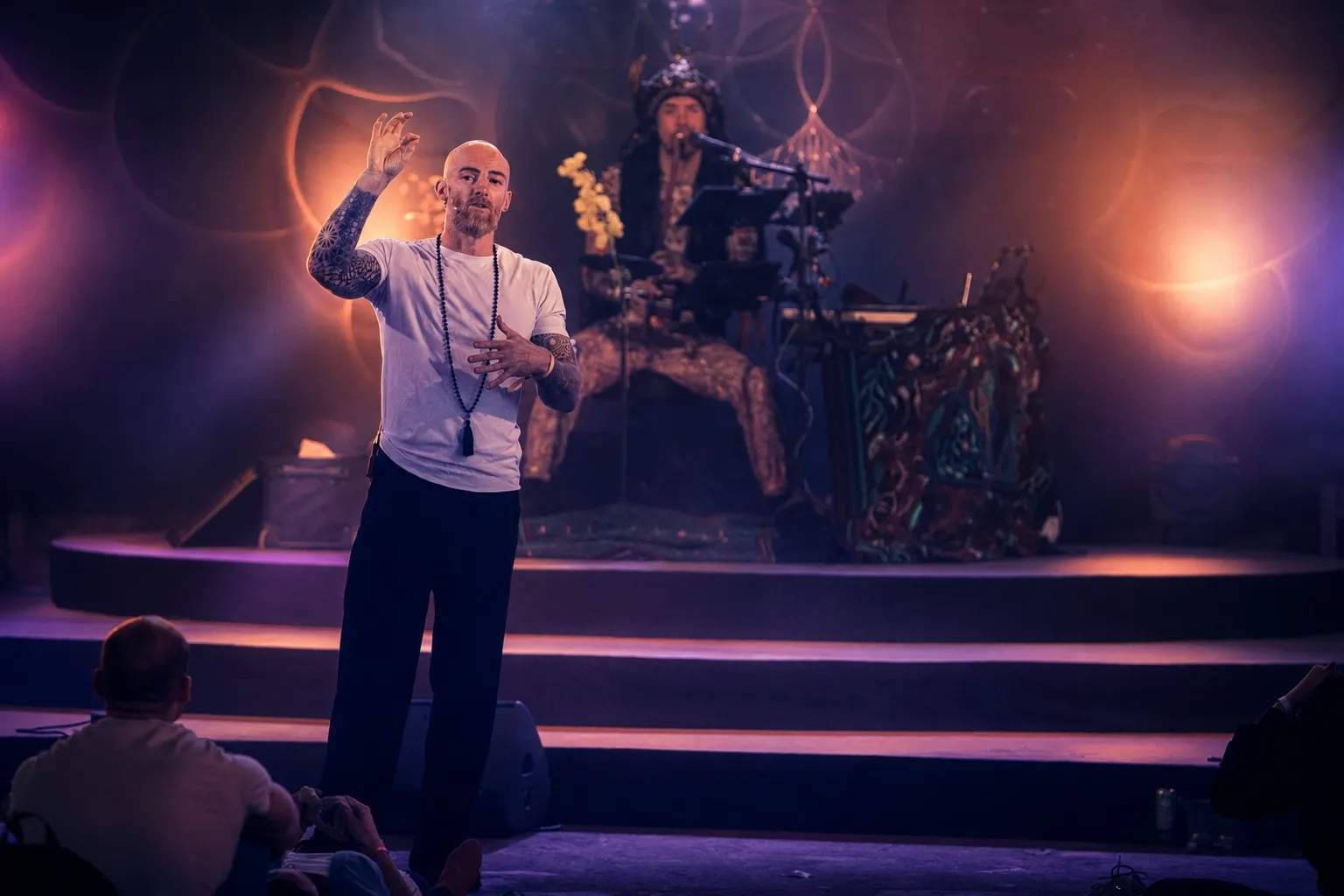
Ancient wisdom meets modern science as breathwork expert captivates audience in Tallinn
In a world obsessed with cutting-edge longevity technologies, breathwork specialist Leigh Ewin delivered a compelling reminder of humanity's most fundamental yet overlooked tool for health and vitality: conscious breathing. Speaking to a packed audience at the HOLOLIFE Summit 2025 Europe in Tallinn last Friday, Ewin challenged attendees to reconsider the estimated 25,000 breaths they take each day as opportunities for transformation rather than unconscious biological functions.
"You have twenty-five thousand chances every single day to decide how you want to show up in this life," Ewin told the hushed crowd, many of whom had just calculated the astronomical number of breaths they had taken in their lifetimes using a simple exercise he facilitated.
The mathematics of breathing and consciousness
Ewin began his presentation with a startling mathematical exercise, asking audience members to multiply 25,000 (daily breaths) by 365 days, then by their age. The resulting figures – representing the total breaths taken in each person's lifetime – prompted a moment of collective reflection.
"How many of those breaths have actually been conscious? How many have you actually connected to in your life?" he questioned, highlighting the profound disconnect most people experience with this vital function. "You know that breathing can happen autonomously, but how many of those breaths have you done your way, the way you want to, in the state that you want?"
The physiological alchemy of breath
According to Ewin, conscious breathing directly or indirectly influences virtually every bodily system, from energy production and hormone regulation to digestion, temperature control, and emotional states.
"We can literally play alchemist in our own body, in our own blood, by adjusting our breathing," he explained. "We can generate more red blood cells, minimize white blood cells that are caused by stress."
This physiological plasticity, he argued, represents the foundation of biohacking – maintaining the body's systems in optimal condition through deliberate practice rather than allowing them to deteriorate from disuse.
"All these systems in our bodies are kind of like elastic bands," Ewin noted. "If you're moving around, you might leave your house one day, walk outside, and see an elastic band on the ground. You walk by one day, one week, three months, six months, a year later, and then you pick up that elastic band—what happens? It might snap or break."
The etymology of breath: What our language reveals
Perhaps the most fascinating segment of Ewin's talk explored the linguistic connections between breathing and concepts of spirituality, energy, and inspiration across multiple languages and cultures.
"In many languages, 'spirit' and 'breath' mean the same thing," he noted. "Spirare in Latin translates to spirit and breath. In Finnish, 'henki, hengitä.' Many other languages are the same."
Ewin traced the root "spire" through English words like inspire, aspire, perspire, and expire, revealing the deep connections between breath and life's fundamental experiences:
"'Inspire' literally means to breathe in," he explained. "When someone's dedicated to their craft, passionate, skilled—inspirational—it has a profound effect on us."
The social dimension of breathing and longevity
As the presentation shifted toward longevity, Ewin addressed a troubling trend: increasing social isolation as people age. Displaying statistics showing how time spent alone increases throughout life, he posed challenging questions about the social aspects of extreme longevity.
"For longevity, if we're living to 115 or 170 years, what do those last years look like? Are you going to be the 130-year-old hanging out with the 40-year-olds?"
The antidote, Ewin suggested, might lie in collective breathing experiences that synchronize human physiology and create profound connections.
"How many examples do we have of people singing together, breathing together, chanting together—tribes synchronizing their breath, like the Maoris in New Zealand, Vikings rowing together, and even the most intimate moments with someone you love?"
This synchronization, he explained, extends beyond mere breath: "Your whole physiology is synchronized—your heartbeats, your hormones—the same way."
Practical application: The breath of inspiration
Midway through his talk, Ewin led the audience through a simple breathing exercise designed to evoke feelings of inspiration and excitement. Participants reported immediate shifts in their emotional states after just five conscious breaths.
"That makes me feel good—excited, something moving inside," Ewin shared after the exercise. "Just five breaths—you can access that anytime."
The balance between body and mind
Throughout the presentation, Ewin repeatedly returned to the concept of breathing as the intersection between conscious control and autonomous function – the bridge between mind and body.
"When we talk about balance, we're really talking about the balance between the body and the mind," he said. "Where these things cross over—where they connect—I call it the magic shit... Some people call it flow state; for others, it might be a very spiritual experience."
Using a vivid analogy of a river meeting the sea, Ewin described this intersection as "one of the most fertile environments you could ever find," rich with possibility and vitality.
As the HOLOLIFE Summit continues through the weekend in Tallinn, Ewin's message resonates as both a practical toolkit for immediate wellbeing and a philosophical framework for understanding longevity beyond mere physical duration. In a conference dedicated to cutting-edge health innovations, his reminder of humanity's most ancient and accessible technology – the conscious breath – may prove to be one of its most enduring takeaways.
Frequently asked questions
How many breaths do we take each day?
Leigh Ewin put it at roughly 25,000, then asked the Tallinn audience to multiply that by 365 and again by their age. The point of the arithmetic was the question that followed: how many of those breaths have you actually been conscious of, or connected to, in your life?
What does language reveal about breath?
Ewin traced the overlap between breath and spirit across languages: spirare in Latin gives both spirit and breath, and Finnish pairs henki with hengitä. He used the etymology to argue that cultures have long treated breathing as something more than gas exchange.
How does conscious breathing affect the body?
Ewin argued it influences virtually every bodily system, from energy production and hormone regulation to digestion, temperature control and emotional state. His framing was that we can play alchemist in our own blood simply by adjusting how we breathe.
About the event
This recap is part of the HOLOLIFE Summit 2025 Europe series, recorded in Tallinn on 14 and 15 June 2025. Read the summary of the whole event or join the next edition, HOLOLIFE Summit 2026 Amsterdam, on 14 and 15 November 2026.
In this story
Comments
Loading comments…