Biohacker Summit 2023 Amsterdam
Liposomal Formulations: Jan Braband On Bioavailability And A Taxi Into Your Bloodstream
By Teemu Arina · · Updated
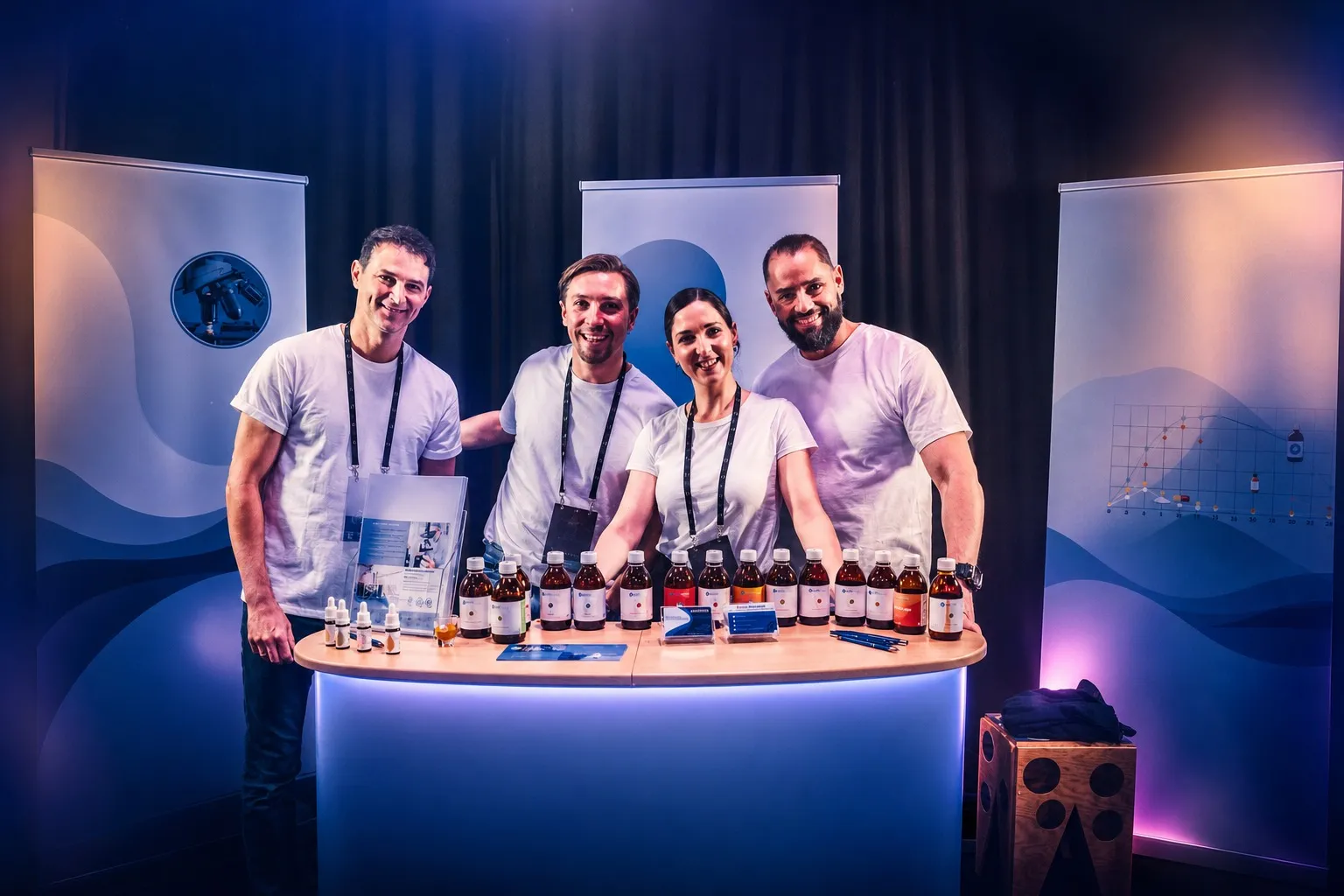
At Biohacker Summit 2023 Amsterdam, A Supplement Industry Problem Was Put Under The Microscope
On Saturday, 14 October 2023, at Biohacker Summit 2023 Amsterdam in the Netherlands, Jan Braband took to the stage with a pitch that was as provocative as it was practical. His presentation, Liposomal Formulations - Taxi Into Your Bloodstream, argued that much of the global supplement industry had been built on a quiet inefficiency: people were swallowing compounds that never truly reached the bloodstream.
Braband, founder of ActiNovo and inventor of the LipoSone production technology, framed himself as a kind of evangelist for a delivery system he believes could redraw the boundaries of supplementation. His message was blunt. The problem was not always the substance itself, but whether the body could absorb it at all.
“Seventy percent of all supplement substances have a significantly reduced bioavailability, and thirty-five percent have a drastically reduced bioavailability, meaning that almost nothing goes where it should be.”
That destination, he said, was the bloodstream, and from there the cells.
The Great Supplement Disconnect
Braband’s central claim rested on what he called the “70/35 rule”. In a market worth billions, he suggested, a vast number of products failed at the most basic level of delivery. Supplements could look powerful in theory, and even dazzling in laboratory studies, while producing far weaker results in actual human use.
He pointed to resveratrol as a familiar cautionary tale. For years, the antioxidant was celebrated in biohacking and longevity circles, buoyed by promising in vitro findings. Yet many in vivo studies failed to reproduce that promise. For Braband, the explanation was not that the molecule had been oversold in principle, but that it rarely got where it needed to go in the human body.
The same broad logic, he argued, applied to other celebrated compounds including curcumin, glutathione, quercetin and fisetin. Their reputations were often built on biological potential. Their commercial weakness lay in absorption.
The Digestive System As Gatekeeper
One of the more compelling parts of Braband’s talk was his insistence on a simple but often overlooked distinction: putting a substance in the mouth did not mean putting it to work in the body.
The digestive tract, he said, functioned less like an open door than a highly selective filter. It was designed to break down food, reject overloads and protect the body from what it perceived as imbalance. That system, useful as it was, often worked against supplementation.
Vitamin C offered an accessible example. A person could easily consume enough to avoid deficiency. But when oral doses climbed sharply in pursuit of immune support or other benefits, the digestive system often pushed back, sometimes violently, through diarrhoea and rapid excretion. In other words, the body treated excess concentration as a problem to be flushed out.
“The ultimate goal is to get any substance into the bloodstream. That is the holy grail: to have the opportunity for every interesting upcoming substance to get into your system so it can really work.”
The Liposome As Trojan Horse
Braband’s proposed answer was the liposome, a microscopic carrier made from phospholipids, the same fundamental material found in human cell membranes. In water, phospholipids arrange themselves into double-layer membranes, creating a spherical structure with space inside for active compounds to be enclosed.
This was the crux of the technology. It was not enough, Braband said, to mix nutrients with phospholipids. The active substance had to be genuinely trapped inside a stable liposomal structure, which required advanced production techniques.
He described the result in memorable terms.
“A liposome hides and masks the ingredients inside. You can compare it to a Trojan horse; it makes substances invisible to the digestive system so they are more than welcome to be resorbed by the body.”
That metaphor did much of the work in the room. The body, primed to reject high concentrations of exposed compounds, instead encountered a phospholipid sphere that looked familiar, even welcome. The cargo inside could pass through digestive scrutiny with a better chance of reaching circulation.
Why Fluid Formulations Mattered
Braband also stressed a more technical point that often escaped consumers: true liposomal formulations had to be fluid. Water was not an optional ingredient but a structural necessity. Without it, the membrane could not form in the first place.
That mattered because many products marketed under the liposomal banner, he implied, risked oversimplifying the science. A real liposome depended on a watery environment and careful manufacturing to keep the active ingredients enclosed. The practical trade-off was that such formulations could not simply be packed with enormous concentrations of the active compound. If too much of the product was just the ingredient itself, the masking effect was compromised.
This invisibility extended even to testing. Braband noted that standard chromatography often failed to detect substances such as coenzyme Q10 inside liposomes unless an enzyme was first used to break the carriers apart. To critics, this might look suspicious. To Braband, it was proof that the mechanism was working as intended.
Closing The Gap Between Lab Promise And Human Results
The larger promise of liposomal delivery, as Braband presented it, was not just incremental improvement but translation. It was a way to narrow the gulf between what substances did in laboratory conditions and what they achieved in real bodies.
“A liposomal formulation closes the gap that exists between in vitro studies in the lab and in vivo effects in people, without the pain and discomfort of a needle.”
That line captured the appeal. Injections had long solved the absorption problem, but at the cost of convenience, comfort and accessibility. Liposomal delivery was presented as the less invasive route to the same basic ambition: reliable entry into the bloodstream.
Braband argued that for compounds with notoriously poor oral bioavailability, this was not a minor upgrade but a fundamental one. In his telling, the choice was often between a proper delivery system and pointless expense.
“For many substances, if you do not use a liposomal formulation, it is a waste of money. It simply goes into the toilet, and you do not want to feed the toilet.”
A New Frontier For Biohackers Or A Sharp Lesson In Consumer Skepticism
There was, beneath the enthusiasm, a broader warning in Braband’s presentation. Consumers had become accustomed to judging supplements by ingredient lists, dose sizes and fashionable science headlines. His argument suggested those measures were often secondary to a simpler question: could the body absorb the compound in meaningful amounts?
For the biohacking crowd gathered in Amsterdam, that was more than a technical aside. It was a challenge to rethink what made a supplement effective. Not the glamour of the molecule, nor the boldness of the label, but the route it travelled once swallowed.
Braband’s talk at Biohacker Summit 2023 Amsterdam did not merely praise liposomes as a clever innovation. It cast them as a corrective to a market too comfortable with the illusion of efficacy. If he was right, the future of supplementation would belong not only to new ingredients, but to better vehicles.
And in that future, the winning technology might be the one that turned a promising compound into what Braband called, with disarming simplicity, a taxi into the bloodstream.
Frequently asked questions
What is the supplement industry's delivery problem?
Jan Braband argued that a vast number of products fail at the most basic level: looking powerful in theory, even dazzling in laboratory studies, while producing far weaker results in actual human use. He pointed to resveratrol as the familiar cautionary tale.
What is a liposome?
A microscopic carrier made from phospholipids, the same fundamental material found in human cell membranes. In water, phospholipids arrange themselves into double-layer membranes, creating a spherical structure with space inside for active compounds to be enclosed and ferried through.
Why must a liposomal product be fluid?
Because water is a structural necessity rather than an optional ingredient. Without it the membrane cannot form in the first place, Braband explained, which means a real liposome depends on a watery environment and careful manufacturing to keep the active ingredients enclosed.
About the event
This recap is part of the Biohacker Summit 2023 Amsterdam series, recorded in Amsterdam on 14 and 15 October 2023. Read the summary of the whole event or join the next edition, HOLOLIFE Summit 2026 Amsterdam, on 14 and 15 November 2026.
In this story
Comments
Loading comments…