
Smart Me
Speaker biography
Govert is an Olympic rower whose expertise spans a diverse range of fields, from biomarkers and nutrition to supplements, consciousness-hacking, mental toughness, and resilience. What sets him apart is his unique blend of expertise and humor, making even the most complex topics relatable and engaging. Having ventured into the realm of extreme biohacking, Govert has explored virtually every modality available, pushing the boundaries of human potential at the highest level.
The following text is generated with artificial intelligence. Accuracy is not guaranteed.
Biohacking & AI: The Future Of Data-Driven Personal Health & Human Performance
“Get to know your body inside and out, learn to understand it, and manage your nutrition, recovery, sleep, and mindset in a way that works for you.”
— Govert Viergever
Description
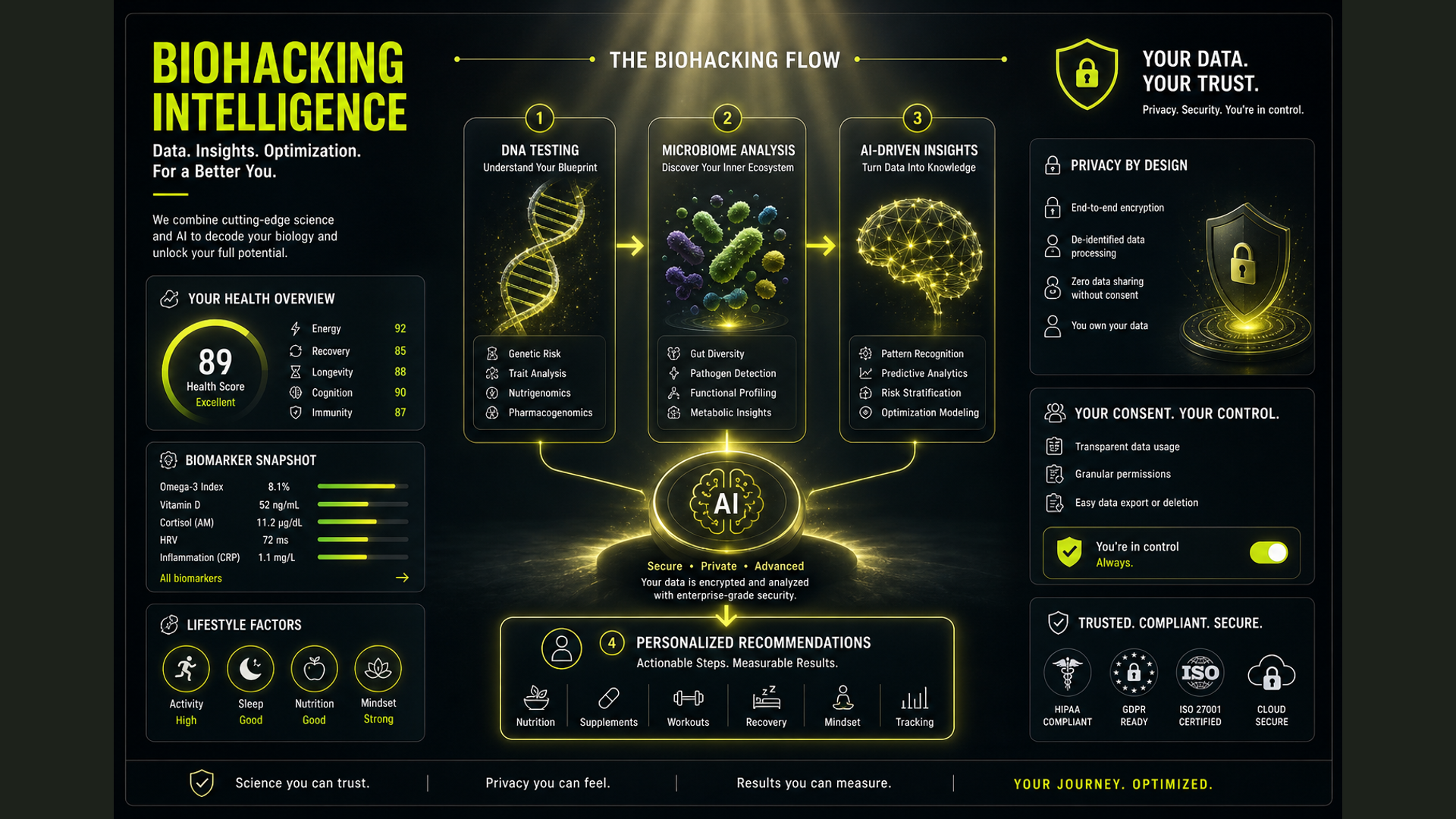
Biohacking leverages AI to synthesize longitudinal biological data—including DNA, microbiome, blood, and physiological metrics—into actionable health insights. By correlating personal genetic predispositions with real-time biometric feedback, this technology optimizes nutrition, recovery, and neurotransmitter balance. While these data-driven platforms offer personalized wellness, they raise critical concerns regarding data privacy, corporate transparency, and consumer trust. Effectively navigating this digital shift requires balancing algorithmic efficiency with human autonomy, ensuring that sensitive personal biological information remains under individual control rather than corporate exploitation.
Summary
- Biohacking uses biological data like DNA, microbiome tests, and blood values to optimize physical and mental health.
- AI platforms can effectively analyze complex, multi-source health data to provide personalized wellness advice.
- Personal health management requires balancing data-driven insights with human coaching to ensure actionable, understandable guidance.
- Integrating lifestyle metrics with biological markers creates a comprehensive foundation for predicting and managing individual health needs.
- Trust, transparency, and data consent are critical concerns when using AI-driven apps to process sensitive personal health information.
Key points
- Managing stress and heart rate can be achieved through specific breathing techniques, which influence brain signals and mental focus.
- The gut microbiome plays a foundational role in human behavior, as a significant portion of neurotransmitters like serotonin is produced there.
- Traditional one-size-fits-all training or health programs may be ineffective for individuals due to unique genetic predispositions and biological variances.
- Data privacy and the ethical handling of personal health metrics by corporations represent a major societal challenge as tracking technologies become more integrated into daily life.
- Cognitive performance and resilience are closely linked to physiological health, where hormonal balance and nutrient absorption directly impact daily mood and social interactions.
Things to learn
- Practice mindful breathing and meditation to regulate your heart rate and prevent mental racing.
- Prioritize gut health by monitoring your microbiome, as it is a key driver of your hormonal balance and mood.
- Tailor your exercise and nutrition to your unique genetic blueprint rather than following generic, "one-size-fits-all" fitness trends.
- Use structured daily routines and deliberate focus to build resilience when facing setbacks or high-pressure environments.
- Maintain a critical, proactive stance on data ownership to ensure you remain the one in control of your personal health metrics.
Notable quotes
- “You are the one holding the steering wheel and you want your life to follow you.”
- “By getting to know your body inside and out, you can manage your nutrition, recovery, sleep, and mindset in a way that works for you.”
- “Consent, transparency, and control over the sharing of personal data are incredibly important.”
- “The key to health lies right in the middle, between measuring yourself with devices and what comes up in your medical tests.”
- “AI is much better at identifying correlations between your DNA, microbiome, and blood values than a human network ever could be.”
Questions to ask
Here are the top 5 questions to ask to further the content of your presentation:
- How can we bridge the gap between AI-driven health recommendations and the human intuitive sense of what our bodies actually need in a given moment?
- In a future where AI synthesizes our DNA, microbiome, and behavioral metrics, how do we prevent the "optimization" of our health from overriding our personal autonomy and lived experiences?
- What happens to the human capacity for resilience and self-discovery when we outsource the interpretation of our physiological signals to an algorithm?
- How can we design systems that use this high-level health data to empower the individual’s decision-making process, rather than creating a dependency on the app’s automated suggestions?
- If we define human "potential" through the lens of data-driven biohacking, how do we ensure we don't lose sight of the qualitative, non-quantifiable aspects of human fulfillment and well-being?
Keywords
Magazine article
Navigating The Future Of Health: Govert Viergever's Vision At NextM 2026
In his presentation, Viergever illuminated the complex world of biohacking, where artificial intelligence meets extensive biological data. This involves transforming DNA, microbiome information, blood metrics, and physiological data into actionable health insights. By correlating personal genetic predispositions with real-time biometric feedback, individuals can optimize various aspects of their health, including nutrition, recovery, and mental wellness.
"You are the one holding the steering wheel, and you want your life to follow you," Viergever declared, urging listeners to take charge of their wellbeing.
The Dual Edge Of Data-Driven Health
While the potential of these data-driven platforms is enormous, Viergever did not shy away from discussing the pressing concerns they raise. Issues of data privacy, corporate transparency, and consumer trust emerged as critical topics. He noted, “Consent, transparency, and control over the sharing of personal data are incredibly important,” recognizing the delicate balance between algorithmic efficiency and individual autonomy.
Personal Insights And Experiences
Drawing from his extensive industry experience, Viergever shared personal anecdotes highlighting the significance of understanding one’s body on a fundamental level. He emphasized the importance of managing personal health by knowing how to regulate heart rate and stress levels through mindful breathing techniques. "By getting to know your body inside and out, you can manage your nutrition, recovery, sleep, and mindset in a way that works for you," he revealed, urging individuals to leverage their unique biological data.
AI's Role In Health Optimization
A central theme of Viergever's talk was the role of AI in identifying correlations that human networks might overlook. He stated, "AI is much better at identifying correlations between your DNA, microbiome, and blood values than a human network ever could be." This capability allows for a personalized approach to wellness, where insights can significantly improve individual life quality.
The Ethical Dilemma Ahead
As groups dive deeper into biohacking and AI-driven health optimization, the ethical implications are becoming increasingly prominent. The challenge lies in navigating an evolving landscape where personal data must be handled with care to prevent misuse. Viergever identified a need for a proactive approach to individual health data management, suggesting that consumer awareness and consent will be fundamental in shaping the future of health technology.
Concluding Thoughts
As the presentation wrapped up, there was a clear transference of knowledge and empowerment from Viergever to attendees. With the rise of AI and biohacking, the future of health management promises to revolutionize personal wellness. Yet, as Viergever poignantly reminded the audience, the true path forward lies in maintaining trust and transparency in data utilization.
"How can I trust him, who is handling this matter?" Viergever asked provocatively, leaving attendees with the challenge of demanding accountability in their health journeys. As we embrace this innovative era, the question remains: who will ultimately hold the reins in the relationship between personal health data and corporate interests? It is a query that will shape the landscape of health technology in the years to come.
“YOU ARE THE ONE HOLDING THE STEERING WHEEL AND YOU WANT YOUR LIFE TO FOLLOW YOU.”
GOVERT VIERGEVER
Social posts
Copy generated post templates for each platform.